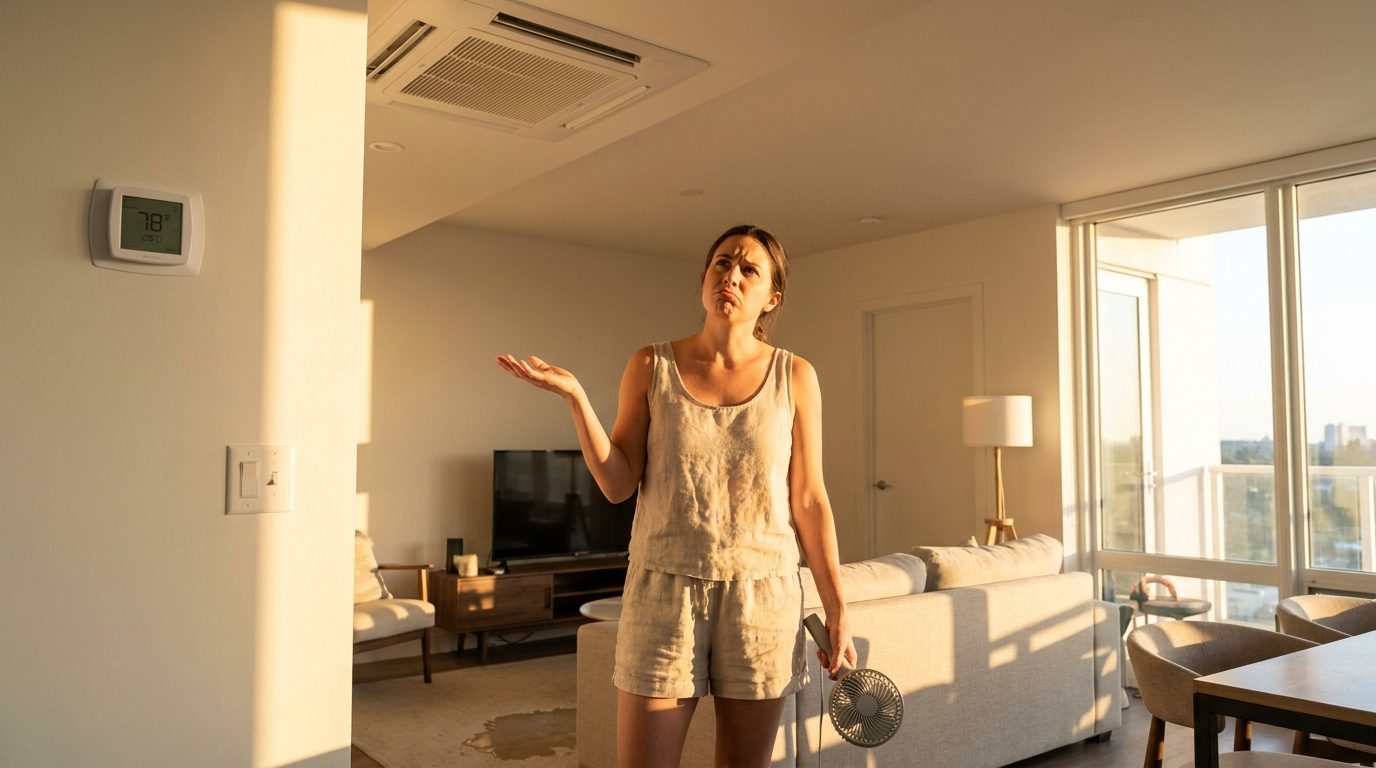

Your AC is running but the house won’t cool. We see this call every summer week from Hesperia to Apple Valley to Victorville to Wrightwood, and the cause is almost never what homeowners assume.
The two-sentence answer: in 70% of the calls we run, the cause is either a dust-loaded outdoor coil (the High Desert dust load is brutal) or a frozen evaporator that started with a dirty filter. The other 30% breaks down across thermostat issues, refrigerant leaks, electrical failures, and compressor problems.
Below are the seven causes ranked by how often we actually see them on service calls, plus what you can check yourself before paying for a diagnostic visit. Most are quick fixes our techs handle on AC repair calls in Victorville the same day.
The 5-minute homeowner check
Before any of the seven causes, run this short list. It’s free, takes five minutes, and rules out the most common easy fixes.
- Check the thermostat. Set it to COOL, set the temperature 5 degrees below the current indoor reading, and confirm the fan setting is on AUTO (not ON). If the fan is on ON, the blower runs constantly and you’ll feel “warm” air between cooling cycles. This is not a failure.
- Pull the filter and hold it to a light. If you cannot see light through it, it’s blocking enough air to freeze the evaporator coil. Replace it.
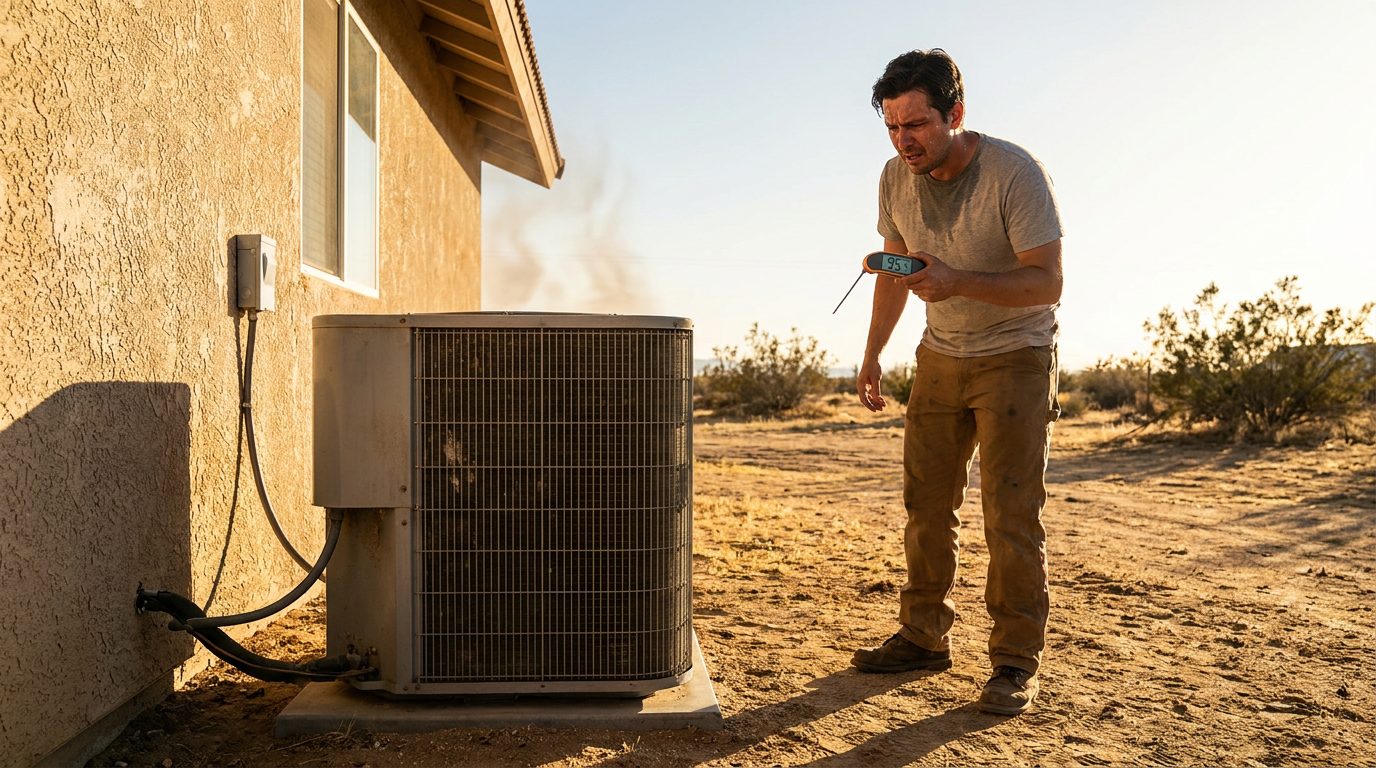
- Walk outside to the condenser. Look at the outdoor coil fins. If they’re packed with cottonwood seed, dust, dryer lint, or grass clippings, they cannot reject heat. We cover what to do about this below.
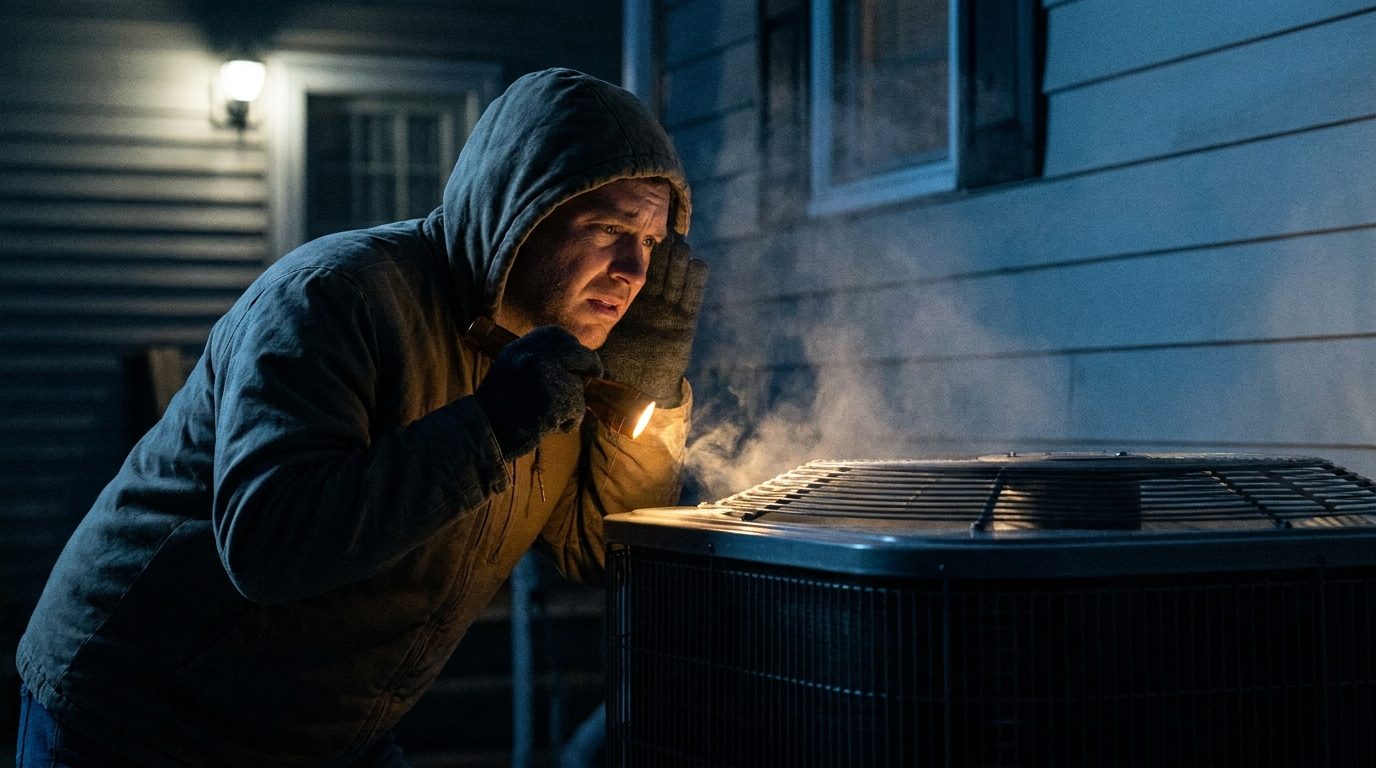
- Listen at the outdoor unit. A buzzing sound without the fan spinning usually means a failed capacitor. A clicking sound with no startup usually means a contactor problem. Both are repair calls.
- Check the breaker. Look at the breaker panel for any tripped breakers, especially after a HD wind event or rolling brownout. Reset once. If it trips again, stop and call us; do not keep resetting.
If none of those resolve it, here are the seven causes in order of frequency.
1. Dust-loaded outdoor coil (the High Desert classic)
This is the single most common cause we see between Hesperia and Lucerne Valley. The outdoor coil’s job is to dump heat from inside your house to the outside air. When the fins are clogged with dust, cottonwood seed, dryer lint, and (during fire season) wildfire ash, the coil cannot dump that heat. The system runs and runs, but the refrigerant pressure rises until the compressor can’t move heat efficiently. Inside, the air at the vent may still feel cool early in the day, but by 3 PM the house is drifting hot and the AC never catches up.
In coastal SoCal this happens every 3-5 years. In the High Desert, with our chronic dust load and Santa Ana wind events, we see it every year on systems that don’t get an annual coil rinse. The fix is straightforward: power off at the disconnect, gentle hose rinse from the inside out (NOT a pressure washer, bent fins cost more to fix than the cleaning), let dry, restart. We do this as part of our maintenance tune-ups.
2. Frozen evaporator coil (filter-related)
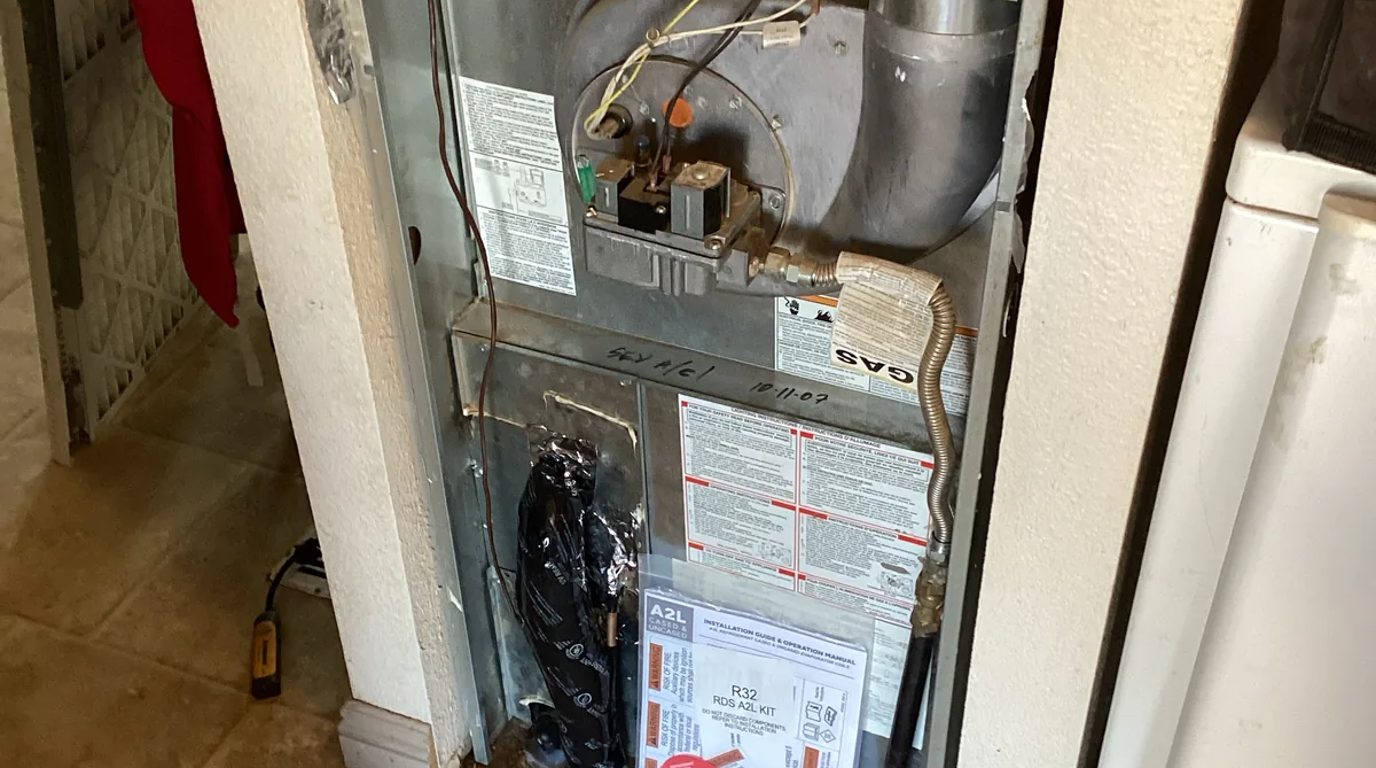
The evaporator coil lives inside your air handler, usually in the attic or a closet. It’s where refrigerant picks up heat from the inside air. If airflow across that coil drops, because of a clogged filter, closed supply registers, or a failing blower motor, the coil temperature falls below freezing and ice forms on the fins. Once iced over, the coil can’t absorb heat, and the AC runs but the air coming out of the vents goes from cool to barely-cool to room temperature.
You’ll often see water dripping from the indoor unit (melted ice running down the drain pan and overflowing it) or ice/frost on the large copper line outside the house. If you see those signs, the fix at home is: switch the thermostat to OFF, leave the fan on AUTO, and let the ice melt for 2-4 hours. Then replace the filter and run again. If it freezes back up, you have a refrigerant charge problem (see #4) or a blower issue.
3. Capacitor failure
The start capacitor is the small electrical component that gives the compressor and condenser fan motors their initial kick. In High Desert heat, capacitors degrade faster than coastal, we’ve replaced 8-year-old capacitors at 110 degrees that read fine at 80 degrees the day before. The classic symptom: outdoor unit hums or clicks but the fan doesn’t spin, OR the fan spins but the compressor doesn’t engage. If you tap the fan blade with a stick (carefully, power off) and it starts spinning, your capacitor is done.
Capacitor replacement is one of our most common service calls. The part is inexpensive; the diagnostic is fast. Replacement total runs $185 to $325 depending on capacitor size and microfarad rating.
4. Low refrigerant from a leak
This is where homeowners often get oversold. AC systems do not consume refrigerant during normal operation, if you’re low, you have a leak. The classic symptoms: the AC runs but the air at the vents is barely cool (not warm, but not properly cold either), and the suction line going into the indoor unit may be frosty even when the rest of the system looks fine.
A bad tech will add refrigerant without finding the leak. A good tech will pressure-test the system with nitrogen, find the leak point (usually a Schrader valve, an evaporator coil pinhole, or a line-set joint), repair it, evacuate the system, and recharge to the manufacturer spec. The cost difference is real: $250 for a “top-off” that fails in 6 weeks vs. $650-$1,400 for a real repair that holds for years. We do the second.
5. Thermostat or control wiring
Sometimes the AC is fine and the thermostat is the problem. Common High Desert thermostat issues: batteries dead (most modern thermostats run on AA batteries even when wired), the thermostat is mounted in direct afternoon sun (so it reads hotter than the rest of the room and short-cycles), or a wire has come loose in the wall. We have replaced more than one “broken AC” by reseating a single loose 24V wire behind the thermostat.
If you can pull the thermostat off the wall, take a quick photo of the back, and see whether anything looks loose or charred, you’ll know before we get there. Don’t touch live wires, but a visual check is fine.
6. Failing blower motor
The indoor blower moves cooled air through your ductwork. If the blower motor is failing, wheel bearings worn, ECM module dying, or capacitor (separate from the outdoor unit’s) gone, the airflow drops, the coil ices, and you get a “runs but doesn’t cool” complaint. We hear this most often on systems 12+ years old, and the fix is either motor replacement ($425-$850) or, if the system is otherwise tired, full air handler replacement.
A clue: if you stand under a supply register and hold a piece of tissue paper up to it, a healthy blower will lift it firmly. A failing one won’t.
7. Compressor failure
The compressor is the heart of the outdoor unit. When it fails, the AC may run electrically, the fan spins, the contactor pulls in, but no cooling happens because no refrigerant is being moved. Compressor failures are catastrophic: a healthy 12-year-old AC almost never has a compressor go without warning, but a system with a long history of running on low refrigerant (see #4) or a damaged outdoor coil (#1) often kills the compressor as the final symptom.
When we diagnose a failed compressor, we usually recommend condenser replacement instead of compressor-only repair. The math: a new condenser is $3,200 to $5,800 installed (depending on size and SEER), and a compressor-only swap on an old system is $1,800 to $3,500 with no warranty extension on the rest of the unit. For most homeowners in Hesperia or Apple Valley, the condenser swap is the better long-term spend.
Quick-reference frequency table
| Cause | How often we see it | DIY check possible? | Typical repair cost |
|---|---|---|---|
| Dust-loaded outdoor coil | Very common | Yes, visual | $129 (tune-up) |
| Frozen evaporator coil | Very common | Yes, look for ice | $0 if filter-caused |
| Capacitor failure | Common | Yes, hum + no spin | $185-$325 |
| Refrigerant leak | Common | No, needs gauges | $650-$1,400 |
| Thermostat/wiring | Occasional | Partial | $85-$250 |
| Blower motor | Occasional | No | $425-$850 |
| Compressor failure | Rare | No | $3,200-$5,800 (replace condenser) |
When to call
Call us at 760-983-2326 if:
- You’ve done the 5-minute check and the AC still won’t cool
- You see ice or frost anywhere
- You hear humming or buzzing without the fan spinning
- The breaker has tripped more than once
- The indoor temperature has been climbing for more than two hours
For same-day service, call before 10 AM. After 6 PM, we run emergency dispatch 24/7 with no after-hours upcharge, the same flat-rate diagnostic applies whether it’s Tuesday afternoon or 2 AM Saturday.
Real prices, real diagnostics, no parts sold you don’t need. We’re family-owned in Hesperia and the techs on staff live in the High Desert too, so we know what summers actually look like out here. See our AC repair service page for more, or read our AC repair cost guide for the full price breakdown.