
Most HVAC blogs don’t write this post because they want you to call them rather than learn the diagnostics. We write it because educated customers ask better questions and accept legitimate quotes faster.
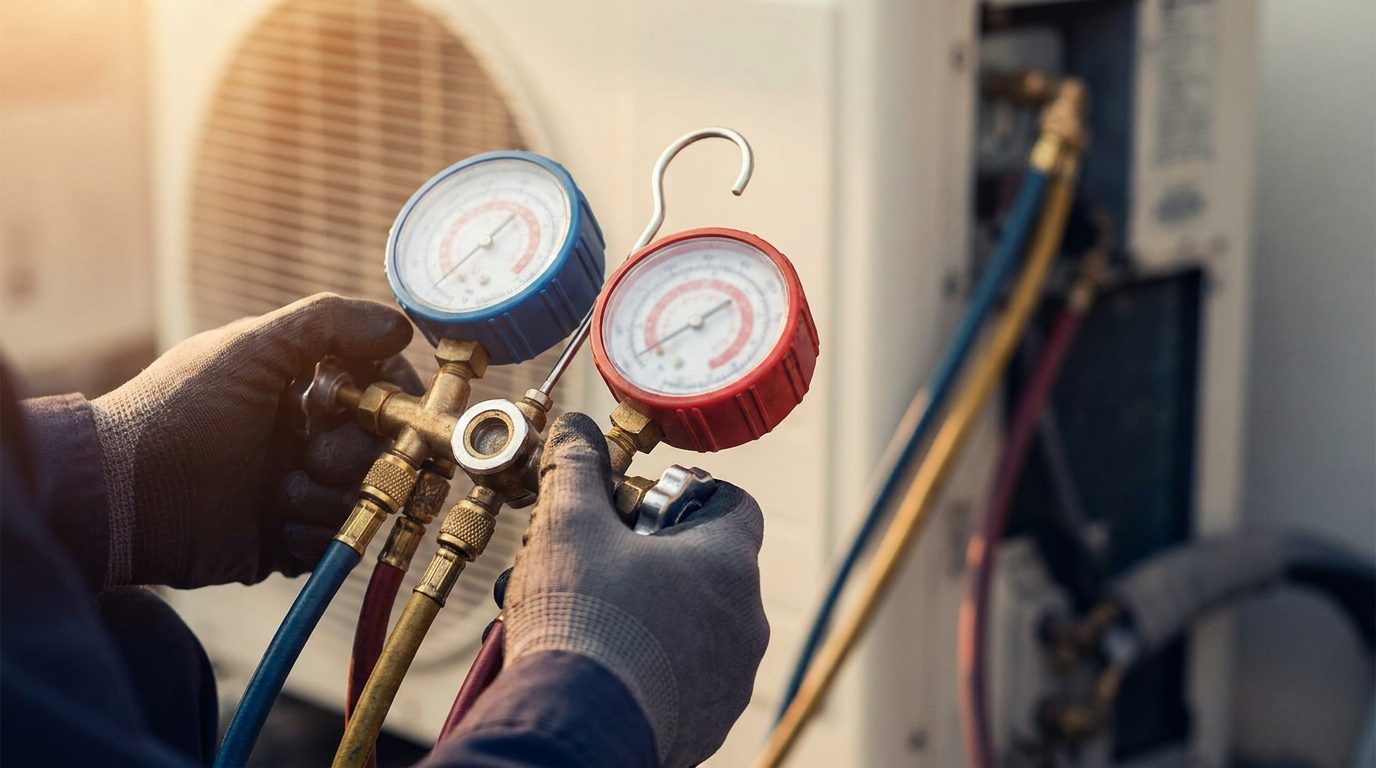
Two-sentence answer: four numbers tell you whether your AC is healthy, high-side pressure, low-side pressure, superheat, and subcooling. A good tech measures all four on every service call and shares the readings.
Below is what each number means in plain language and what good readings look like. New to HVAC terminology? Bookmark our HVAC101 glossary for plain-English definitions of every term used here.
The four critical numbers
1. Low-side pressure (suction pressure)
What it is: Pressure in the line returning refrigerant from the indoor coil back to the compressor.
Why it matters: Indicates whether the indoor coil is absorbing heat correctly. Too low = airflow problem or low charge. Too high = overcharge or restriction.
Healthy ranges (HD outdoor temp around 95°F):
- R-410A: 115-130 PSI
- R-22: 65-75 PSI
- R-454B (A2L): 110-125 PSI
2. High-side pressure (discharge pressure)
What it is: Pressure in the line carrying compressed refrigerant from compressor to condenser.
Why it matters: Indicates whether the outdoor coil is rejecting heat correctly. Too low = compressor weakness. Too high = dirty outdoor coil, restriction, or overcharge.
Healthy ranges (HD outdoor temp around 95°F):
- R-410A: 350-380 PSI
- R-22: 250-280 PSI
- R-454B: 330-360 PSI
(These shift with outdoor temperature. On a 110°F afternoon, high-side runs 50-80 PSI higher than the 95°F numbers above.)
3. Superheat
What it is: Degrees above the refrigerant’s boiling point at the suction line.
Why it matters: Confirms refrigerant is fully evaporating before returning to compressor. Liquid refrigerant returning to a compressor damages it permanently.
Healthy range: 8-15°F for most fixed-orifice systems. 6-10°F for TXV (thermostatic expansion valve) systems.
Diagnostic meaning:
- Superheat too high (>15°F) → undercharged refrigerant or airflow restriction at indoor coil
- Superheat too low (<5°F) → overcharged refrigerant
- Superheat at zero → liquid is reaching the compressor, STOP IMMEDIATELY
4. Subcooling
What it is: Degrees below condensing temperature at the liquid line leaving the outdoor unit.
Why it matters: Confirms refrigerant is fully condensing to liquid in the outdoor coil before being metered to the indoor coil.
Healthy range: 8-12°F on most R-410A residential systems. Varies by manufacturer.
Diagnostic meaning:
- Subcooling too low (<5°F) → undercharged or restricted condenser airflow
- Subcooling too high (>15°F) → overcharged
- Subcooling at zero → vapor reaching the metering device, system not working
What a good service report looks like
Here’s the actual format we email after every JCE service call:
JCE Service Report - 2026-07-15
Hesperia, CA

Equipment:
  Goodman GSXC18 3-ton, R-410A, installed 2019

Outdoor conditions:
  102°F dry bulb, 18% RH

Indoor conditions:
  Return air: 78°F dry bulb, 42% RH
  Supply air: 58°F dry bulb
  Delta-T: 20°F (healthy)

Refrigerant measurements:
  Low side: 122 PSI
  High side: 378 PSI
  Superheat: 11°F (target 8-12°F) - OK
  Subcooling: 10°F (target 8-12°F) - OK

Electrical:
  Compressor amp draw: 14.2A (rated 15.5A) - OK
  Outdoor fan amp draw: 1.2A (rated 1.5A) - OK
  Capacitor: 45/5 µF (rated 45/5 ±6%) - OK
  Contactor: clean, no pitting - OK

Indoor:
  Filter: replaced (MERV 11, 20x25x1)
  Drain line: cleared
  Coil: clean

Combustion (furnace side, fall visit):
  CO: 12 ppm (well below 100 ppm OSHA limit) - OK
  Flue draft: -0.04 in WC - OK

Recommendations:
  None. System healthy.
  Next visit: Spring 2027 AC tune-up.
That’s the kind of report you should expect from a real tune-up. If your tech doesn’t share this level of detail, ask for it. If they can’t produce it, they didn’t actually measure these things.
What bad-faith techs do
Common HVAC industry red flags:
1. “You need refrigerant” without leak diagnosis. AC systems don’t consume refrigerant. If you’re low, you have a leak. A tech who says “just need a top-off” and doesn’t pressure-test or leak-search is selling you a bandage. The leak will come back in 6 weeks.
2. Refusal to share pressure readings. “Trust me, it needs a recharge” without numbers is not diagnosis. Ask: “What were the low-side and high-side pressures? What’s the superheat?” A good tech will pull out their phone with the readings.
3. Charging refrigerant by pressure alone. Refrigerant should be charged by weight (manufacturer spec) or by precise superheat/subcooling targeting. “Charged to 350 PSI” is not real diagnosis, pressure depends on outdoor temp and load. A pressure-only charge is wrong half the time.
4. Quoting compressor replacement without proof. Compressor failure should be confirmed by: starting amp draw, running amp draw, ohms across windings, megger insulation test. “Sounds like the compressor’s bad, you need a new one” without numbers is not diagnosis.
5. Maintenance plan with vague deliverables. A real maintenance plan includes specific measurements per visit. If the plan brochure just says “we’ll tune up your system,” ask what’s measured. Should include: refrigerant pressures, superheat/subcooling, electrical, combustion (furnace), airflow.
What to ask your tech
If you’re on a service call right now, four questions to ask:
- “What’s the low-side and high-side pressure?”
- “What’s the superheat and subcooling?”
- “What’s the amp draw on the compressor?”
- “Can you email me the readings after?”
A good tech answers all four without hesitation and follows up with the email. A reluctant tech tells you not to worry about it.
When this matters most
The above is most important on:
- Annual tune-ups, confirms system health, catches drift before failure
- Repair calls involving refrigerant, verify the diagnosis matches the readings
- Post-install commissioning, new install should be measured + documented within 24 hours of startup
- Warranty disputes, readings document what you got
When to call
Call 760-983-2326 for a real tune-up. We measure all four numbers (and the dozen others not in this post), document them, and email you the report.
See our maintenance services for tune-up scheduling, AC repair page, or about JCE for company background. Family-owned in Hesperia, CSLB #998538.