
“What size AC do I need?” is one of the most-asked questions we get on quote calls. And the honest answer is: probably not what your last HVAC contractor told you.
Two-sentence answer: a typical 1,800-2,200 sq ft Hesperia or Victorville home with average insulation needs 3 to 4 tons of AC capacity, not the 5 tons many contractors quote by habit. Oversizing is the single most common mistake in HD installs, and it costs you comfort, dehumidification, and equipment life.
Want a number for your own home in 30 seconds? Run our free AC Sizing Calculator for a Manual J quick estimate. Below is how the full sizing process works and what to ask your contractor. We run it on every job, from AC installs in Apple Valley to Wrightwood retrofits.
Why rule-of-thumb sizing fails
The standard rule-of-thumb most contractors use: “500-600 square feet per ton.” A 2,000 sq ft home becomes a 3.5-4 ton system.
That rule was developed in moderate climates with average insulation, average window count, and tight ductwork. The High Desert breaks several assumptions:
- Outdoor design temp. Rule of thumb assumes 95°F design. HD is 102-104°F. Adds load.
- Solar gain. West-facing glass on a clear 110°F afternoon adds 200-400 BTU/hour per sq ft. Most rules of thumb don’t see your window orientation.
- Duct losses. Attic ductwork in 140°F HD attics loses 15-25% of conditioned air. Rules of thumb don’t see your duct condition.
- Building tightness. A 1995 tract home is leakier than a 2015 build. Rules of thumb don’t see your air sealing.
A real Manual J load calc accounts for all of this and arrives at a specific BTU/hour number for cooling and another for heating. That number → tonnage selection → equipment.
What goes into a Manual J calculation
Manual J is the ACCA (Air Conditioning Contractors of America) standard for residential load calculation. It’s also required by California Title 24 for any new construction or major HVAC replacement. The inputs:
- Square footage of each conditioned room
- Ceiling height (vaulted vs 8 ft adds load)
- Window count, size, orientation (north, south, east, west matters hugely)
- Window type (single-pane, dual-pane, Low-E)
- Wall R-value (R-13 for older, R-19 for current code, R-21 for premium)
- Attic R-value (R-30 minimum, R-38 typical, R-49 premium)
- Floor R-value (slab vs raised, insulated vs not)
- Air infiltration rate (ACH50, ideally measured via blower door)
- Number of occupants (each person adds ~250 BTU)
- Indoor appliances (kitchen, laundry add load)
- Design temperatures for cooling and heating (location-specific)
- Duct condition + location (attic vs conditioned space)
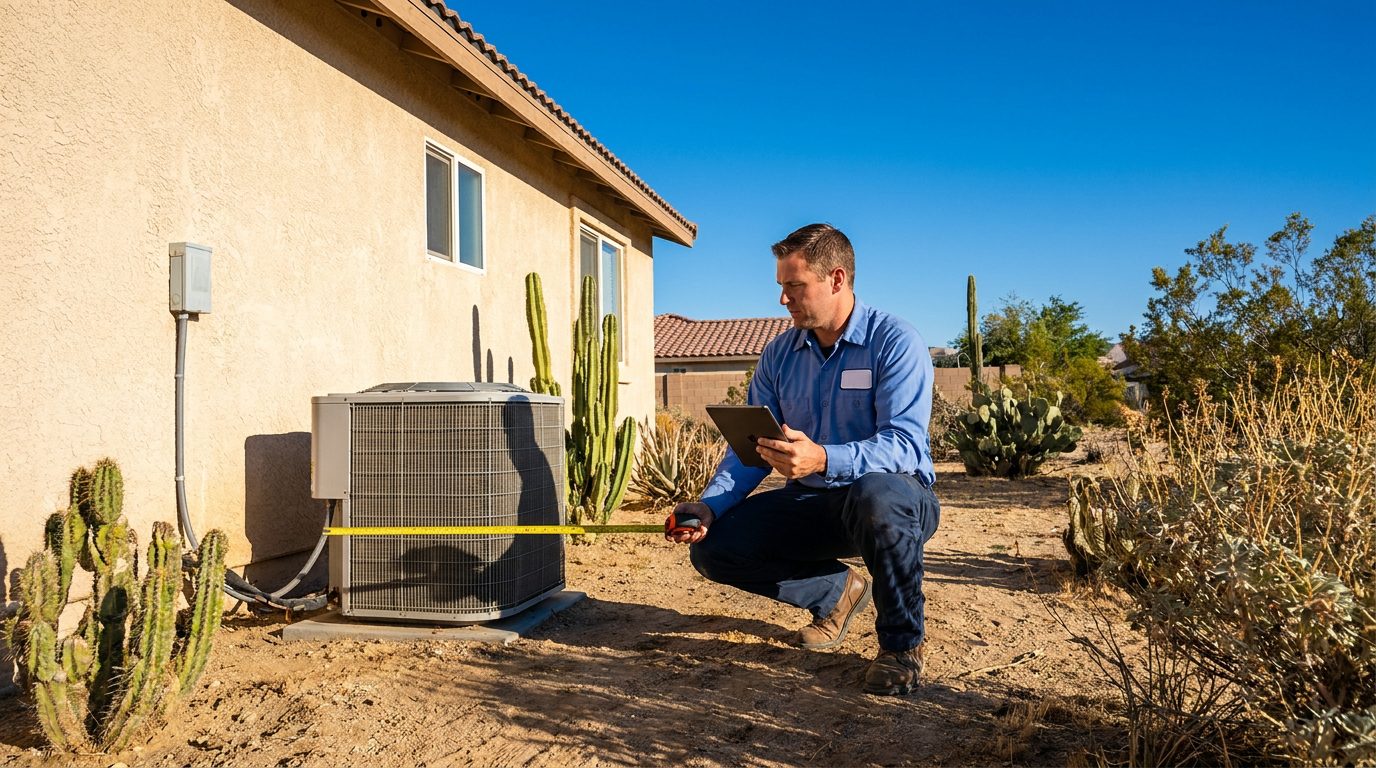
For HD installs we use a tablet-based Manual J tool that pulls the design temps from the AccuLoads database, lets us walk the home and measure each input, and outputs the load number. Takes 20-30 minutes during a quote visit.
HD design temperatures by city
| City | Cooling design (1%) | Heating design (99%) | ASHRAE zone |
|---|---|---|---|
| Hesperia | 103°F | 24°F | 14 |
| Apple Valley | 104°F | 22°F | 14 |
| Victorville | 104°F | 25°F | 14 |
| Adelanto | 105°F | 23°F | 14 |
| Phelan (low) | 100°F | 19°F | 14 |
| Wrightwood | 88°F | 11°F | 16 |
| Lucerne Valley | 105°F | 22°F | 14 |
| Riverside | 102°F | 35°F | 10 |
| San Bernardino | 102°F | 33°F | 10 |
| Rancho Cucamonga | 100°F | 35°F | 10 |
(Design temps from CA Title 24 Joint Appendix JA1. 1% cooling design is the temp not exceeded 99% of cooling hours; 99% heating design is the temp not exceeded 1% of heating hours. These are the right numbers to size for, not the absolute extreme.)
Real sizing examples
| Home | Sq ft | Insulation | Glass | Manual J cooling load | Tonnage |
|---|---|---|---|---|---|
| 2005 Hesperia tract home | 1,850 | R-13 walls / R-30 attic | 12 windows, 2 west-facing | 38,500 BTU/hr | 3.5 tons |
| 1998 Apple Valley tract home | 2,100 | R-13 walls / R-19 attic | 14 windows, 3 west-facing | 46,200 BTU/hr | 4 tons |
| 2018 Victorville new build | 2,400 | R-21 walls / R-38 attic | 11 dual-pane windows | 42,000 BTU/hr | 3.5 tons |
| 1985 Hesperia ranch | 1,650 | R-11 walls / R-19 attic | 8 single-pane windows, 4 west | 41,500 BTU/hr | 3.5 tons |
| 2021 Rancho Cucamonga | 2,800 | R-21 walls / R-49 attic | 18 dual-pane Low-E | 48,000 BTU/hr | 4 tons |
Two things worth noting:
-
The 2018 Victorville build (2,400 sq ft, modern insulation) needs LESS cooling capacity than the 1998 Apple Valley tract home (2,100 sq ft, older insulation). Manual J shows this; rule of thumb hides it.
-
The 1985 Hesperia ranch (only 1,650 sq ft but bad insulation + single-pane + west glass) needs almost the same capacity as the 1998 Apple Valley tract home that’s 25% larger. Rule of thumb would have put it at 2 tons; reality is 3.5 tons.
The oversizing trap
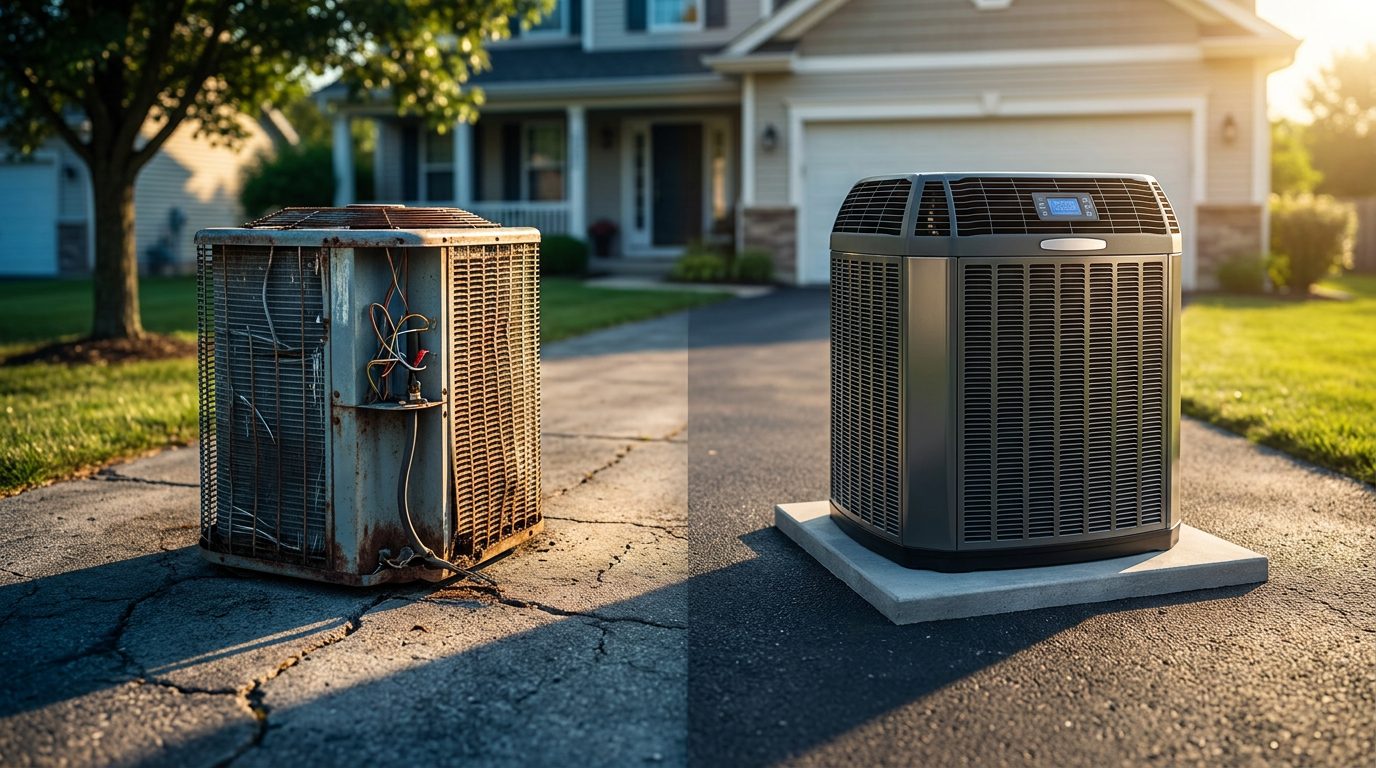
Most HD contractors size by square footage rule of thumb, then “go up half a ton just to be safe.” This is the oversizing trap. The result:
Short-cycling. The AC runs 5-8 minutes, satisfies the thermostat, shuts off. Indoor temp drifts up over 15 minutes. AC kicks back on. Cycle repeats hundreds of times per day. The compressor wears out from start-stop fatigue. The blower never settles into the long, slow runs that move air evenly through ductwork.
Poor dehumidification. Even in dry HD climate, indoor humidity from cooking, showering, and human respiration needs to be removed. AC dehumidification only happens during the long runs after first-stage compressor startup. Oversized systems never get there.
Hot/cold spots. Short cycling means rooms farther from the indoor unit never have time to cool. The thermostat (usually in the hallway) reads “satisfied” while the back bedroom is 4 degrees warmer than the living room.
Wasted money on equipment + install. A 5-ton system costs $800-$1,400 more installed than a 3.5-ton system. If you only need 3.5 tons, that’s wasted money up front and ongoing.
How to know if your current AC is oversized
Signs of oversizing on an existing system:
- Runs in short bursts (under 10 minutes) even on hot afternoons
- Room-to-room temperature swings 4+°F
- Indoor humidity feels muggy even with AC running
- Bedrooms at the far end of the duct run never cool down properly
- Outdoor unit cycles on and off audibly within the same hour repeatedly
If 3+ of those match your current system, your old AC was oversized. Don’t replace it with another oversized one.
What to ask your contractor
When quoting AC replacement, ask:
- “Did you run a Manual J for this quote?”, If no, find another contractor.
- “What’s the design cooling load in BTU/hour?”, They should answer with a specific number.
- “What tonnage matches that load and why?”, There’s a rounding decision (most equipment comes in half-ton increments). Should be the closest size at or just below the load.
- “What’s my ductwork situation and how does it affect sizing?”, If your ducts are leaky or in unconditioned attic, the calc should account for it.
- “Did you check my actual window count and orientation?”, A real Manual J knows this.
If a contractor refuses to share the Manual J output or balks at the conversation, walk away. Sizing is the foundation of a good install.
When to call
Call 760-983-2326 for a free in-home estimate. We run Manual J on every install quote and share the worksheet with you. No magic numbers, no rule-of-thumb shortcuts.
See our AC installation page for what we install or Heat Pump or Furnace for High Desert Homes if you’re weighing electrification.