Homeowner guide · 2026-05-06
How to Prep Your HVAC for a 110-Degree High Desert Heatwave
Practical High Desert heatwave prep: capacitor checks, coil cleaning, thermostat strategy for 110-115F days in Hesperia, Apple Valley, and Victorville.
200+ Reviews
5.0 on Google

Accredited
BBB A+ Rating
CSLB Licensed
#998538
Quick answer
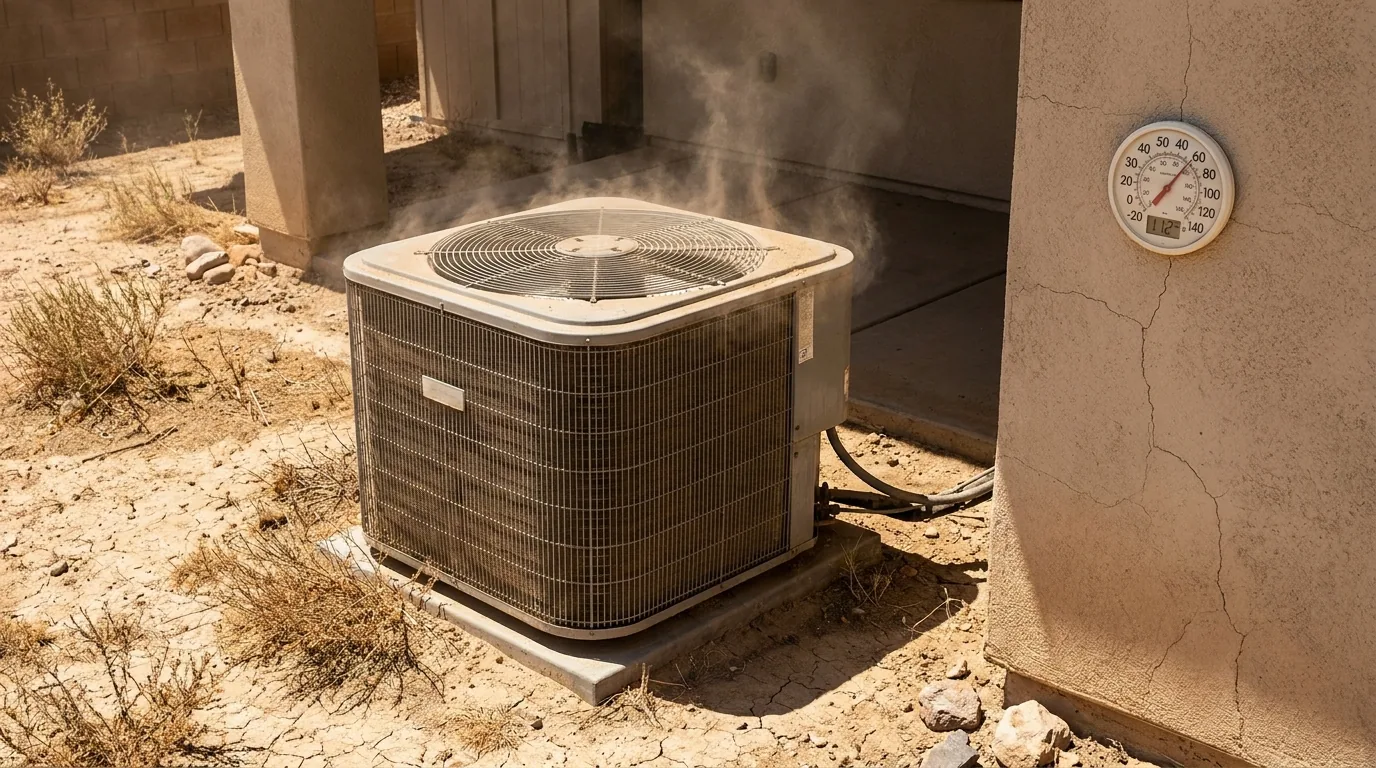
High Desert heatwaves push outdoor temperatures to 110-115F multiple days each summer, mostly in July and August. Capacitors are the single most common heatwave failure because their internal heat rating sits around 85C and rooftop or sun-baked condensers often exceed that. Pre-heatwave maintenance, a clean condenser coil, and a thermostat strategy that runs the AC continuously rather than cycling are the three highest-impact steps a homeowner can take.
Summers in Hesperia, Apple Valley, and Victorville routinely break 110F, and the higher elevations along Bear Valley Road and east Apple Valley can push 113-115F when a high-pressure dome parks over the Mojave. That is the thermal environment your air conditioner has to handle, and it is brutal on equipment that was sized for normal conditions and installed years ago. Most summer breakdowns we run on are not from old age. They are from a single failing component (almost always the run capacitor) that decided to give up during the hottest 72-hour stretch of the year. The good news is that nearly all heatwave failures are predictable and preventable if you do a small amount of work in May or early June. This guide walks through what to check, what to clean, what to ignore, and how to run the system during the peak so you do not turn a five-day heatwave into a $600 service call.
Pre-Heatwave Equipment Check (May or Early June)
The right time to look at your AC is before the first 100F day, not after the system stops cooling on a Saturday afternoon. A pre-season inspection covers four basic items. First, pull the disconnect, remove the access panel on the outdoor condenser, and visually inspect the run capacitor. A bulged top, leaking oil, or rust at the terminals all mean the capacitor is failing. Second, listen for the start of a cooling cycle. A healthy unit ramps up smoothly. A clicking relay that does not engage the compressor, or a low humming followed by silence, both point to capacitor or contactor problems. Third, check airflow at the supply registers in every room. Weak airflow in some rooms but not others usually means a duct issue. Weak airflow everywhere usually means a dirty filter or a return blockage. Fourth, look at the refrigerant lines where they enter the house. The larger insulated line should feel cold to the touch when the system is running. The smaller copper line should feel warm. Anything outside that pattern is a sign refrigerant charge is off. None of these checks require tools beyond a screwdriver and a flashlight, and they will tell you with about 80 percent confidence whether you are heading into summer with a healthy system.
Capacitor Health and Why It Matters Most
The run capacitor is a small cylindrical component inside the outdoor condenser that gives the compressor the electrical kick it needs to start each cycle. Capacitors are rated for an internal temperature of roughly 85C, which is fine in normal conditions but marginal when the cabinet itself is sitting in 115F desert sun and the internal cabinet temperature climbs another 20-30F above ambient. Heat is the primary aging mechanism, which is why capacitors that test fine in March often fail in late July. Visual signs of a failing capacitor are the bulged top (most reliable), oil leakage at the base, and rust at the terminal posts. Audible signs are a clicking sound when the AC tries to start but the compressor does not engage, or short cycling where the compressor runs for 30 seconds and then shuts off. A capacitor swap is a $150-$300 repair, but only if you catch it before the compressor itself overheats trying to start against a weak capacitor. A failed capacitor that takes the compressor with it turns into a $1,500-$3,500 repair or pushes you toward replacement. The math here is simple. Replace any capacitor showing visual signs of failure before the heatwave hits.
Condenser Coil Cleaning
The outdoor condenser is a heat exchanger. Hot refrigerant from inside the house enters the coil, the fan blows ambient air across the coil to dump that heat, and the now-cooler refrigerant cycles back in. If the coil is coated in dust, cottonwood fluff, dryer lint, or the fine sandy dust that the Mojave produces in spring and summer, the coil cannot dump heat efficiently. The compressor compensates by running longer and hotter, which raises head pressure, which shortens compressor life and trips the high-pressure safety on the worst days. Cleaning the coil is straightforward. Cut power at the disconnect. Remove the top grill or fan assembly if the unit allows. Use a garden hose with moderate pressure (not a pressure washer, which bends fins) and rinse from the inside out so debris exits through the fins rather than getting pushed deeper into the coil. A foaming coil cleaner sold at any HVAC supply house helps with stuck-on dust. Do this once before the season starts and again midsummer if you live near open desert, dirt roads, or active landscape work. A clean coil can drop compressor head pressure by 30-50 PSI on a hot day, which is the difference between a system that runs all summer and one that nuisance-trips at 4pm in August.
Refrigerant Charge Signs
Refrigerant levels are something you cannot DIY check accurately, but you can read the symptoms. A correctly charged system on a 110F day will produce a temperature split (the difference between return air and supply air) of about 18-22F. If your return air at the thermostat is 80F and the air coming out of the registers is 64F, that is a healthy 16F split with some heat loss in the ducts, which is fine. If the split is under 12F, the system is undercharged, overcharged, or has airflow issues. The most common cause in High Desert systems over 8 years old is a slow leak at a flare fitting or a corroded evaporator coil. Other symptoms include ice on the larger copper line at the outdoor unit, oil residue at any joint or connection, and a hissing sound that comes and goes. None of these are emergencies, but all of them mean the system is going to struggle during a heatwave and should be looked at before peak season. We charge per pound for refrigerant, R-410A runs around $30-$50 per pound and the newer R-454B around $50-$80 per pound at current 2026 supplier pricing.
Thermostat Strategy During the 110+ Peak
The single biggest mistake homeowners make during a heatwave is dropping the thermostat to 68 or 70 thinking it will cool the house faster. It does not. Residential AC systems are sized to maintain about a 20-25F differential between outdoor and indoor temperature on a design day. When it is 110F outside, your system can realistically hold about 85-90F indoor without working past its design limits. Set the thermostat at 76-78F during the peak hours of 2pm to 7pm and let the system run continuously. Continuous run is more efficient and less destructive than short cycling, because every compressor start draws 5-7 times the amperage of a steady run and that startup heat is what kills capacitors and contactors. Use ceiling fans in occupied rooms, close blinds on south and west-facing windows, avoid running the oven or dryer during peak hours, and accept that 78F with a fan moving air will feel like 74F still air. If you have a programmable or smart thermostat, set a schedule that pre-cools the house to 74F by 1pm so the system has a head start before the worst heat hits. Crashing the thermostat at 4pm guarantees the system runs flat-out during the worst possible operating conditions.
What to Do If Your AC Fails Mid-Heatwave
If the AC stops cooling during a heatwave, the first thing to do is shut the system off at the thermostat. Continuing to run a failed system can compound the damage, especially if the failure is electrical or refrigerant-related. Check the obvious items first. Look at the breaker panel for a tripped breaker (reset it once, but if it trips again, leave it off). Check the filter, a fully clogged filter can ice up the indoor coil and shut down airflow. Look at the outdoor unit. If the fan is spinning but no air is moving, the fan motor may be running backwards (capacitor issue). If the fan is not spinning at all but you hear a hum, that is also capacitor. Once you have done the safe checks, get on the phone. Same-day dispatch fills up fast during heatwaves. Most contractors run 8-12 hour wait times during peak weeks, and some go to 24-48 hours. Service Agreement members get priority dispatch and skip the diagnostic fee. In the meantime, move to the coolest part of the house (usually north-facing rooms or a basement if you have one), close blinds, set up box fans for cross-ventilation in the evening when outdoor temps drop, and check on elderly neighbors and family. Heat illness is real and the High Desert sees heat-related ER visits every summer.
Why a Service Agreement Pays During Heatwaves
Our Service Agreement is $15 per month or $180 per year and includes one heating and one cooling tune-up annually plus 10 percent off parts and labor. The part that matters most during a heatwave is priority dispatch. When we are running 8-12 hour same-day wait times in late July, members get pushed to the front of the queue. The math on the agreement is straightforward. A single capacitor replacement found during the spring tune-up runs $150-$300. The same failure during a heatwave with the system already down runs the same parts cost plus the urgency premium some contractors charge plus the cost of a hot night in the house. The annual cost of the agreement is less than the cost of a single emergency call, and it includes the inspection that catches the capacitor before it fails. We are not pushing this because it makes us money. We are pushing it because the alternative is a homeowner sitting in a 95F house at 9pm in August waiting for the next available appointment.
Quick checklist
Action items.
- ✓ Inspect outdoor capacitor for bulged top, oil leak, or rust at terminals (May or early June)
- ✓ Clean condenser coil with a garden hose, rinse inside-out, repeat midsummer if near desert dust
- ✓ Replace air filter and verify all return grilles are unobstructed
- ✓ Check refrigerant lines: large insulated line cold, small copper line warm when running
- ✓ Test thermostat scheduling, pre-cool to 74F by 1pm before peak heat
- ✓ Set thermostat at 76-78F during 2pm-7pm peak, run continuously not on/off
- ✓ Close blinds on south and west-facing windows during peak hours
- ✓ Sign up for Service Agreement before peak season for priority dispatch
- ✓ Identify the coolest room in the house in case of mid-heatwave failure
- ✓ Save 760-983-2326 in your phone for fast same-day dispatch
When to call us
Don't wait too long.
Call JC Energy Solutions at 760-983-2326 if your system shows any of the warning signs in this guide. Bulged capacitor, ice on the refrigerant line, hissing at the outdoor unit, weak temperature split, or any short-cycling behavior all warrant a service call before the next heatwave hits. We dispatch from our Hesperia office on Main Street and run trucks across Hesperia, Apple Valley, Victorville, Adelanto, Phelan, Oak Hills, Wrightwood, and Lucerne Valley. Pre-season tune-ups in April, May, and early June still have open scheduling. Once we hit late June and the first 105F day, same-day availability tightens fast. Service Agreement members get priority dispatch during peak weeks, which during a multi-day heatwave can mean the difference between a same-day fix and a 36-hour wait.
Financing available · GreenSky + Wisetack
See financing options →200+
Five-star reviews
A+ Accredited 2020
ACCA · EPA 608
Certified technicians

Preferred Vendor
7+ yrs
Family-owned
24/7
$0 diagnostic w/ repair
Factory-authorized dealer:



Frequently Asked Questions
How hot does it actually get in the High Desert during a heatwave?
What is the most common AC failure during a heatwave?
Should I set my thermostat lower during a heatwave?
How long is the typical wait for service during a heatwave?
Is it safe to keep running my AC if it is barely cooling?
Can I clean the outdoor condenser coil myself?
What does the Service Agreement cost and what does it cover?
Sources + references
Authority sources cited.
- →NOAA / National Weather Service: Heat hazards
- →CDC: Extreme heat and your health
- →Cal/OSHA: Heat illness prevention
- →Ready.gov: Extreme heat preparedness
External links open in a new tab. JCE has no commercial relationship with these organizations unless explicitly noted.