

High Desert HVAC guide
Your furnace is
sized for sea level.
Victorville sits at 2,700 feet. Under the National Fuel Gas Code a gas furnace loses about 4 percent of its rated output per 1,000 feet of elevation, so we run altitude-correct sizing and factory high-altitude conversion on every High Desert install.
200+ Reviews
5.0 on Google

Accredited
BBB A+ Rating
CSLB Licensed
#998538
The short version
High Desert gas furnaces must be derated for altitude: about 4 percent of rated output is lost for every 1,000 feet above 2,000 feet, per the National Fuel Gas Code. That runs from roughly 2.8 percent in Victorville at 2,700 feet to about 16 percent in Wrightwood at 6,000 feet. A furnace tuned for sea level burns rich, wastes gas, and runs undersized on cold mornings. We apply factory high-altitude conversion and a Manual J air-density correction on every install, and confirm the derate does not apply on our lower Inland Empire cities under 1,200 feet.
Challenge 1
Altitude derate
What goes wrong: manufacturer Btu ratings are set near sea level. Install that same furnace at 3,000 to 6,000 feet and it puts out measurably less heat than the nameplate says, while burning richer than it should.
Why it happens: thinner high-elevation air carries less oxygen, so the burner needs less gas to match it. The National Fuel Gas Code (NFPA 54) accounts for this with roughly a 4 percent output derate per 1,000 feet above 2,000 feet. Every Victor Valley city is above that line.
How we build for it: we install the factory high-altitude kit (burner orifice plus manifold-pressure adjustment), size to the derated output with a Manual J air-density correction, and document manifold pressure and combustion numbers before we leave. You get a furnace that fires clean and actually hits the heat load on the coldest morning.
| City | Elevation | Furnace derate | Gas service |
|---|---|---|---|
| Victorville | 2,700 ft | ~2.8% | Natural gas |
| Helendale & Oro Grande | 2,700 ft | ~2.8% | NG / propane |
| Adelanto | 2,800 ft | ~3.2% | NG / propane |
| Lucerne Valley | 2,800 ft | ~3.2% | Propane |
| Apple Valley | 2,900 ft | ~3.6% | Natural gas |
| Hesperia | 3,200 ft | ~4.8% | Natural gas |
| Phelan | 3,800 ft | ~7.2% | Propane |
| Oak Hills | 4,200 ft | ~8.8% | NG / propane |
| Wrightwood | 6,000 ft | ~16% | Propane |
Derate computed at about 4 percent per 1,000 ft above 2,000 ft per the National Fuel Gas Code (NFPA 54); shown as approximate. Exact high-altitude kit values are per appliance and per manufacturer, which we confirm at install. Cooling capacity is affected far less (roughly 1 to 3 percent) and is handled separately in the load calc.
Most of the furnaces we replace sit on the valley floor, where the derate is small enough that a sea-level bid misses it. Our Victorville furnace installation and furnace installs in Apple Valley pages show how the correction goes into a real replacement quote.
Calculate your furnace's derate →How altitude works
The higher you live,
the less heat you get.
A furnace rated at sea level loses about 4% of its output for every 1,000 ft above 2,000 ft. Same nameplate, less delivered heat the higher you climb.
Sea level
0 ft
Victorville
2,700 ft
Hesperia
3,200 ft
Oak Hills
4,200 ft
Wrightwood
6,000 ft
01
Thin air carries less oxygen, so the burner can't hit its rated output.
02
A sea-level furnace run as-is burns rich, wastes gas, and makes more carbon monoxide.
03
JCE installs the factory high-altitude conversion (orifice + manifold pressure) to recover rated heat.
Delivered output for a typical gas furnace; derate computed at about 4% per 1,000 ft above 2,000 ft per the National Fuel Gas Code (NFPA 54). Cooling capacity is affected far less.
Challenge 2
Mojave dust & coil fouling
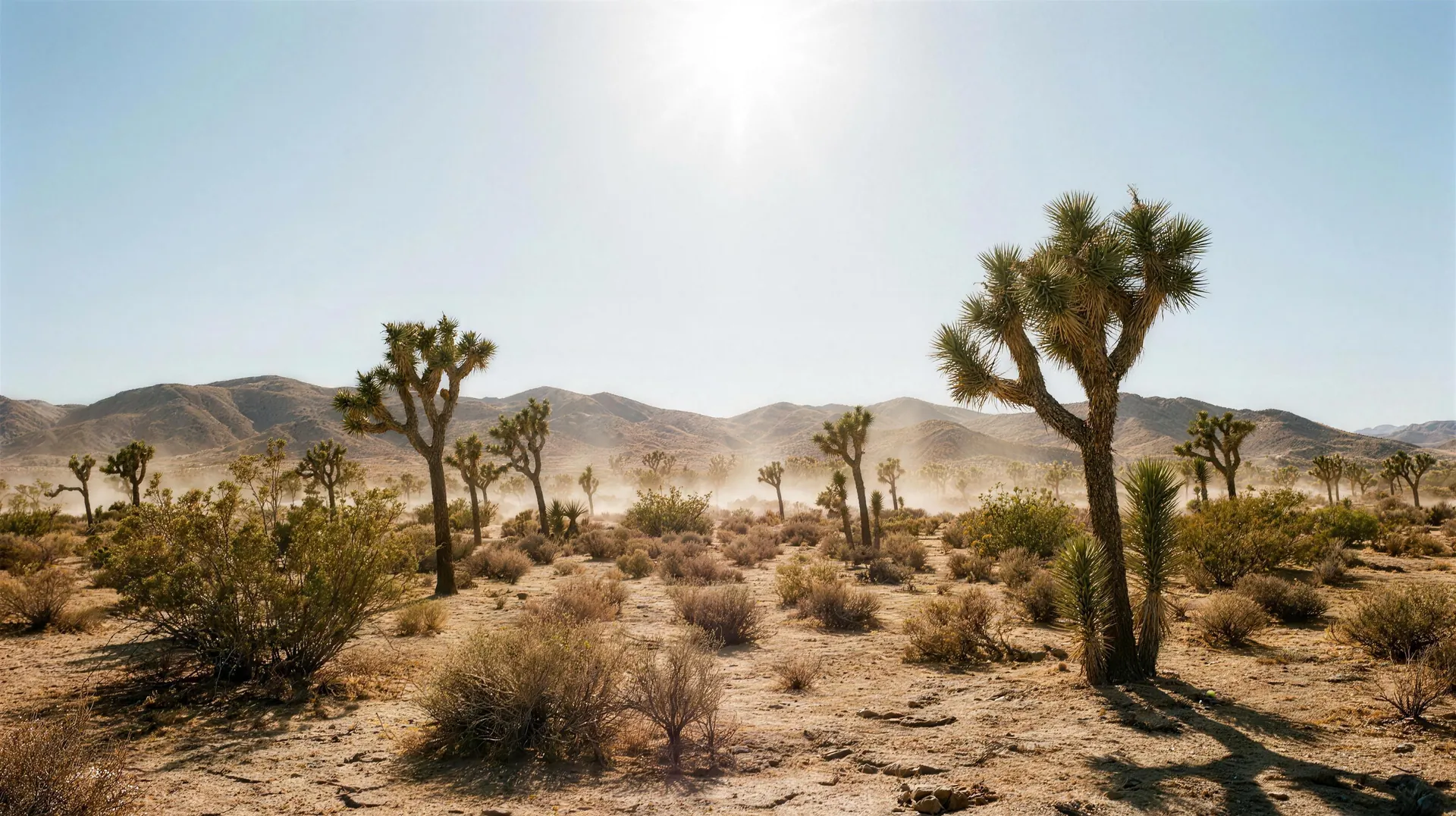
High Desert wind events drive fine grit and dust off open desert and dry lakebeds straight into outdoor condenser coils. A packed coil cannot shed heat, so the system runs longer, works harder, and loses cooling efficiency over a season. Valley-floor coastal installs never see this load.
We clean coils as part of every diagnostic and maintenance visit, not as a separate upsell, and on heavily wind-exposed properties we recommend a coil-coating treatment and more frequent cleaning to hold rated capacity. It is the cheapest performance you can buy out here.
Challenge 3
Desert heat & capacitor life
High Desert summers run average highs in the mid-to-upper 90s, with multi-day heat waves that push past 105 to 110 degrees several times each July and August. A sun-baked outdoor unit can exceed the internal heat rating of its run capacitor, which is why a failed capacitor is the most common summer breakdown we see out here.
We carry the common capacitor sizes on every truck so most summer no-cool calls are fixed on the first visit, and we check capacitor health on every maintenance stop before the July heat takes a marginal one down.
Straight talk
Altitude is a furnace and combustion issue, not a reason to oversize your AC. And it only applies up here. Our Inland Empire cities (Riverside, San Bernardino, Fontana and the rest) sit under about 1,200 feet, below the code line, so they need no altitude correction at all. We tell you which side of that line your home is on before we quote.

Primary lender
GreenSky
Promotional plans (some 0% APR introductory periods). Loans for the GreenSky® consumer loan program are provided by Synovus Bank, Member FDIC.
Call 866-936-0602 for financing costs and terms.
Buy-now, pay-over-time
Wisetack
Soft credit check at application, no hit to your credit score. Built for home services. Approval typically returns in minutes.
Available at checkout. Terms based on credit profile and amount financed.
Frequently Asked Questions
Does altitude really change how a furnace is sized in the High Desert?
What is a high-altitude conversion?
Does altitude derate my air conditioner too?
Do the Inland Empire cities need altitude correction?
What happens if an installer skips the altitude derate?
Which High Desert cities are affected the most?
200+
Five-star reviews
A+ Accredited 2020
ACCA · EPA 608
Certified technicians

Preferred Vendor
7+ yrs
Family-owned
24/7
$0 diagnostic w/ repair
Factory-authorized dealer:



Sized for your elevation