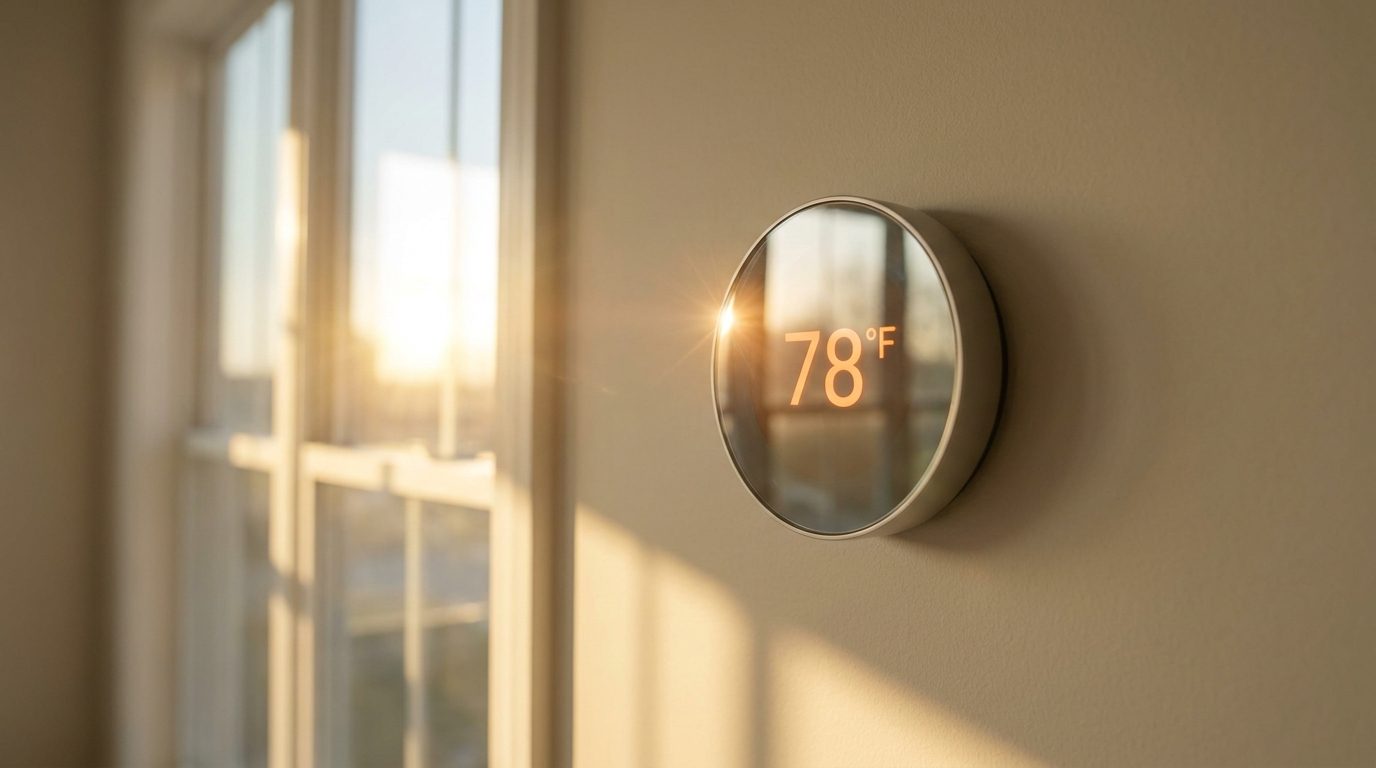
Every coastal-California HVAC blog says “set your thermostat to 78°F in summer.” That rule was written for Long Beach, not Hesperia.
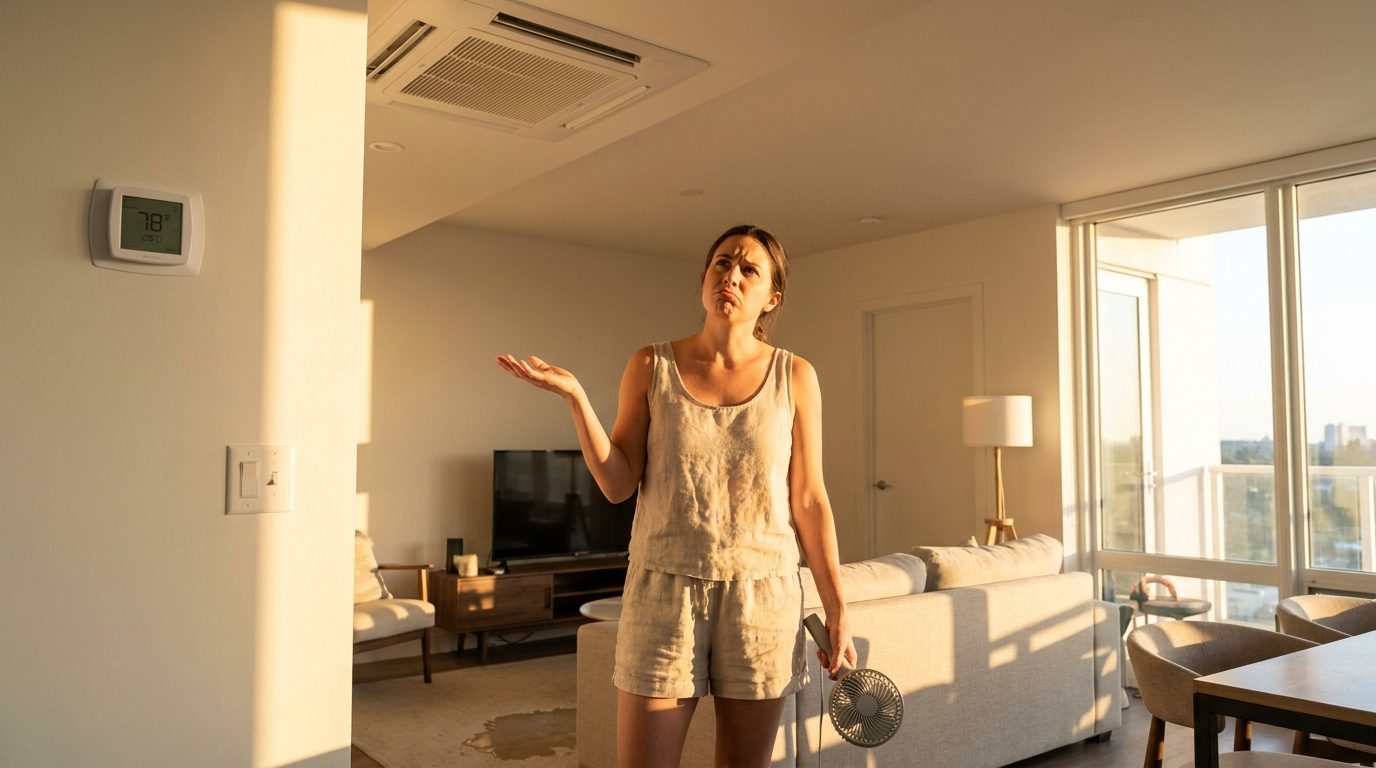
In the High Desert, the difference between 78°F and 76°F isn’t just two degrees of comfort. It’s the difference between “this house feels OK” and “we’re running fans in every room and still sweating after sundown.” The reason is radiant heat: HD attics hit 140-160°F by 3 PM, the west walls of your house radiate heat inward for hours after sundown, and the indoor felt-temperature stays higher than the thermostat reading until late evening.
Two-sentence answer: most High Desert homes do best at 76°F as the baseline summer setpoint, paired with SCE TOU-aware pre-cooling that drops it to 73-74°F in the 1-3 PM off-peak hours and relaxes to 78°F during the 4-9 PM peak window. Below is how to set up that strategy and what to expect on your bill. It’s the same setup our Victorville crews dial in on tune-up visits.
Why 78°F doesn’t work in HD
The DOE 78°F rule assumes:
- Indoor radiant temperature equals air temperature (true in coastal homes with good insulation and minimal sun exposure)
- Outdoor temperature stays under 90°F most of the day (true on the coast)
- AC oversize is rare (true in homes built post-2000 on the coast)
In the High Desert, all three assumptions break. Radiant heat from west-facing walls keeps felt-temperature 2-4°F higher than air temperature in the afternoon. Outdoor highs run 105-115°F. And we see a lot of older oversized 5-ton ACs on 1,800 sq ft tract homes, they short-cycle, never run long enough to dehumidify properly, and the air at the vents feels cool but the room never gets there.
The realistic HD summer baseline is 75-77°F, not 78°F. Add 1°F if you have great insulation and a north-facing primary living area; subtract 1°F if you have lots of west-facing glass.
Understand your SCE rate plan first
This is where most thermostat advice falls apart. The “right” setpoint depends entirely on what your electricity costs per kWh, and SCE has multiple residential rate plans. Look at your last bill to see which one you’re on.
| Plan | Off-peak | Peak (4-9 PM weekdays) | Notes |
|---|---|---|---|
| TOU-D-PRIME | ~25¢/kWh | ~51¢/kWh | Most common; default for newer customers |
| TOU-D-4-9PM | ~24¢/kWh | ~52¢/kWh | Similar TOU but slightly different baselines |
| TOU-D-A | ~22¢/kWh weekday, ~17¢ weekend | ~46¢ summer peak | Older opt-in plan |
| Domestic (tiered, no TOU) | tier-based, ~22-44¢ | n/a | Legacy; SCE has moved most customers off this |
(Rates from SCE’s 2026 published schedule. Yours may vary slightly based on enrollment date and baseline allocation.)
If you’re on TOU-D-PRIME or TOU-D-4-9PM (most likely), the peak rate is roughly 2x off-peak. That’s the entire reason pre-cooling makes sense.
The pre-cool strategy
Here’s the schedule we run on most HD homes with TOU-D rate plans:
| Time | Setpoint | Why |
|---|---|---|
| 9 PM - 3 PM | 76°F | Baseline; AC runs as needed |
| 1 PM - 3 PM | 73°F (pre-cool) | Drop indoor temp during off-peak so structure absorbs cooling |
| 3 PM - 4 PM | 75°F | Transition; AC backs off |
| 4 PM - 9 PM (peak) | 78°F | Let indoor temp drift up; minimize AC kWh at peak rates |
| 9 PM | 76°F | Resume baseline |
The math: by pre-cooling to 73°F before 4 PM, you’re storing “cooling” in the home’s thermal mass (drywall, floors, furniture). When the AC backs off during peak, the indoor temperature rises slowly because that stored mass releases cool gradually. Most homes hold within 2-3 degrees of pre-cool through the peak window.
Bill impact for a typical Hesperia 1,800 sq ft home, July, 3-ton AC:
| Strategy | Avg daily AC kWh | Peak-window kWh | Monthly AC cost |
|---|---|---|---|
| Hold 76°F all day (no TOU strategy) | 45 | 16 | $310 |
| Pre-cool + peak relax (above schedule) | 47 | 6 | $235 |
Savings: ~$75/month in July, ~$60/month June and August. Across summer, $200-$250 saved per AC. That’s the entire cost of a quality smart thermostat in one season.
What about straight all-day 78°F?
If you hold 78°F all day with no pre-cool, you save vs holding 76°F (less total runtime) but you give up the bigger TOU savings. You also live with 78-80°F felt-temperature for most of the afternoon, which in HD with radiant load is uncomfortable.
Bill comparison, same 1,800 sq ft Hesperia home:
| Strategy | Monthly AC cost July | Felt comfort |
|---|---|---|
| Hold 76°F all day | $310 | Comfortable |
| Hold 78°F all day | $245 | Warm in afternoon |
| Pre-cool + 4-9 PM peak relax (above) | $235 | Comfortable except 6-8 PM |
Pre-cooling slightly edges out a flat 78°F on cost AND wins on comfort for most of the day. The trade-off is the 6-8 PM window when the house drifts to 78°F under peak rate. Ceiling fans help.
Smart thermostats that actually do this
Three options we install regularly:
- Ecobee Premium / Smart Enhanced, best SCE integration, pre-cool optimizer learns your home’s thermal response, supports remote sensors so you can prioritize cooling the bedroom you actually use. $190-$280.
- Nest Learning Thermostat, strong scheduling, less precise TOU optimization than Ecobee but better aesthetic. $200-$280.
- Honeywell T9 / T10 Pro, solid value, supports outdoor sensor pairing for adaptive control, slightly clunkier app. $130-$200.
We don’t recommend the cheapest non-Wi-Fi programmable thermostats. They save vs leaving a non-programmable on all day, but they don’t see SCE TOU rates and they don’t pre-cool. The $130-200 Wi-Fi tier pays back in one summer for any HD household on TOU-D-PRIME.
Other free or cheap wins
While you’re optimizing the thermostat, three other moves stack savings:
- Ceiling fans, occupied rooms only. Fans cool people, not rooms. Running a fan in an unoccupied room is just adding heat (the motor) to the room. Run fans only where someone is.
- Close west-facing blinds before 2 PM. Direct solar gain on west glass adds 200-400 BTU/hour per square foot of glass. Even cheap blackout curtains cut this in half.
- Insulate attic access hatch. Most HD attic hatches are 1/4” plywood with no weatherstrip. Patch the gap with foam tape and add R-13 rigid foam on top. $20 in materials, drops attic heat infiltration noticeably.
- Run a swamp cooler on dry days. HD’s 18-32% summer humidity is perfect evaporative cooling country. A tuned swamp cooler uses 1/4 to 1/8 the electricity of central AC and works great below 95°F outdoor temps. Many HD homes run evap morning/evening and AC only during peak afternoon.
When the thermostat strategy can’t save you
If your bill stays high after pre-cool + peak relax + smart thermostat, the underlying system probably needs help. Common culprits:
- AC is oversized (short-cycling means kWh efficiency drops)
- Ductwork in the attic is leaking conditioned air into 140°F attic space
- Insulation R-value is below current code (R-38 minimum in HD climate zone 14-15)
- Refrigerant charge is off (system runs but inefficiently)
We diagnose all four during a tune-up or duct-blast test. Call 760-983-2326 or read more about our maintenance services to schedule. If your system is 12+ years old and bills keep climbing, our AC installation page covers replacement options at every efficiency tier.
For deeper troubleshooting, see AC Running But Not Cooling? 7 High Desert Causes.