
Every HVAC blog says “change your filter every 90 days.” That advice was written for coastal Carolina, not Hesperia in July or Victorville in fire season. Here’s the real filter cadence for High Desert homes, plus the upgrade math for getting away from monthly filter swaps entirely.
Two-sentence answer: 1-inch filters in HD homes need replacement every 30-45 days summer/wildfire season, 60 days otherwise. A 4-inch media cabinet with MERV 13 filter lasts 6-12 months and pays for itself in convenience after 2-3 cycles.
Below is the detail.
Why HD filters fill up faster
Three factors stack:
1. Chronic dust load. Wind across the Mojave + low vegetation cover + dry surface conditions = constant fine dust suspended in air. Even with the AC off, dust settles on attic ductwork and gets pulled in next time the blower runs. We routinely pull filters at 30 days that look like they’ve been in coastal homes for 90.
2. Pollen + cottonwood season. Spring brings cottonwood seed, tumbleweed dust, and a heavy pollen bloom that hits HD harder than coastal. The seed fluff in particular loads pleated filters fast.
3. Wildfire smoke. May-November (sometimes earlier with Santa Ana events) brings smoke from fires across SoCal. PM2.5 particles are exactly what HVAC filters are designed to catch, but a smoke event in a single day can load a filter to where it normally takes a month.
Coastal homes don’t see any of these. The 90-day standard was set for them.
Filter types ranked
| Filter | MERV | Catches | Useful in HD? |
|---|---|---|---|
| Fiberglass (cheap green) | 1-4 | Big dust, hair | No. Protects blower only. Skip. |
| Pleated economy | 5-7 | Most dust, lint | Marginal. Better than fiberglass but limited. |
| Pleated standard | 8-11 | Dust, pollen, pet dander, mold spores | Yes. Sweet spot for 1-inch filters. |
| Pleated MERV 13 | 13 | Above + smoke particulates, viral aerosols | Yes, but verify your system can handle the static pressure. |
| HEPA (true) | 17-20 | Everything down to 0.3 microns | No for whole-house, too restrictive for residential systems. Use in portable units only. |
For most HD homes, MERV 11 pleated 1-inch is the right buy at the box store. MERV 13 is appropriate if your system can handle the airflow restriction (most variable-speed blowers can; some older PSC blowers can’t).
The 1-inch filter cadence by season
| Season | Cadence | Why |
|---|---|---|
| Spring (Mar-May) | 30-45 days | Cottonwood + pollen + dust |
| Summer (Jun-Aug) | 30-45 days | Heavy AC use + dust + wildfire potential |
| Fall (Sep-Nov) | 30 days | Peak wildfire smoke season |
| Winter (Dec-Feb) | 60 days | Lower runtime, less dust |
If you forget to check, here’s the calendar version: replace on the 1st of every month from March through November. December and February, replace on the 1st. January you can usually skip if the filter still passes the light test.
The light test
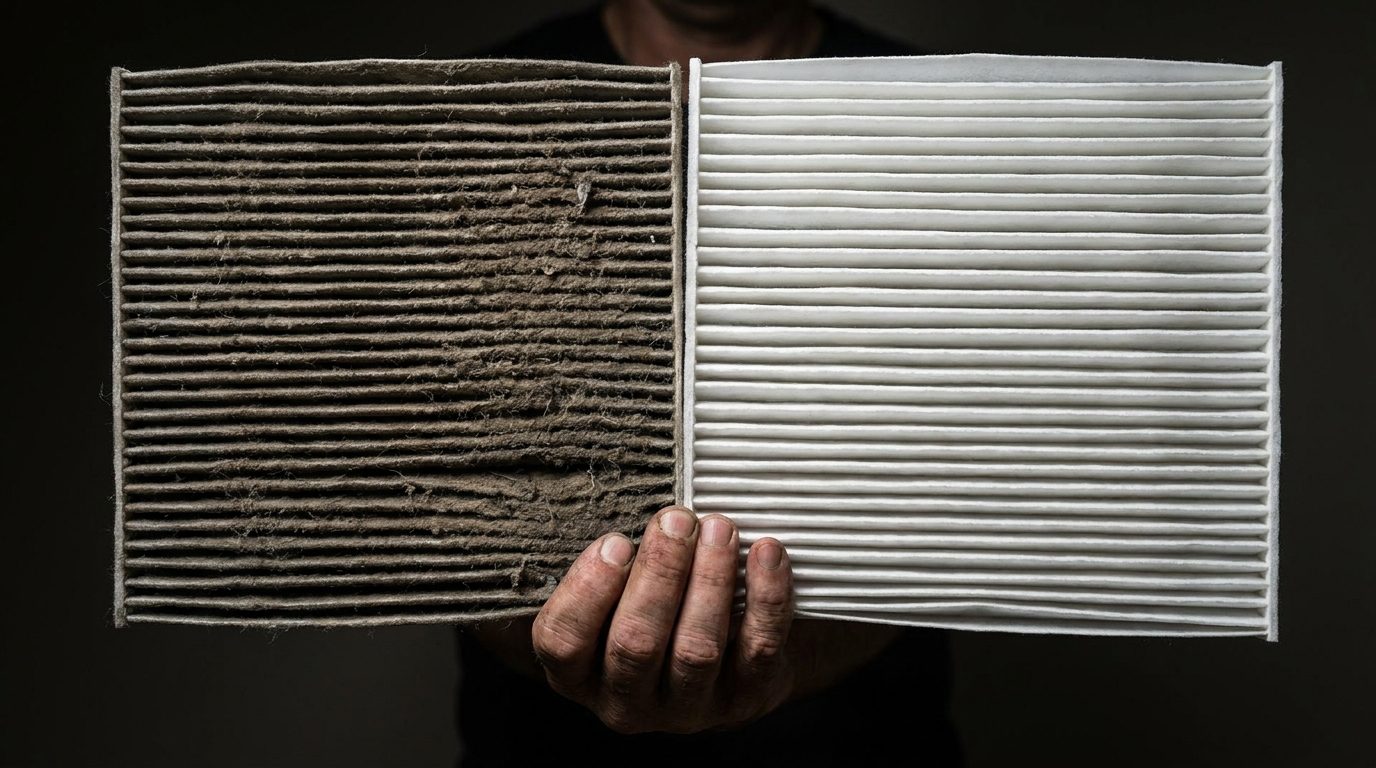
Hold the filter to a sunny window or shine a flashlight through it.
- See clear light through most of the filter → still good
- See light through some areas but darker patches in others → it’s working, replace soon
- See little to no light through the filter media → replace now
This is the only test you need. Skip the calendar reminder and just check the filter monthly.
Wildfire smoke protocol
When PM2.5 climbs over 50 (check airnow.gov for your zip):
- Check filter weekly during the event
- Replace as soon as it fails the light test, even if it’s only 2 weeks in
- Set thermostat to “fan: AUTO” not “ON”, running fan continuously when outdoor air is bad pulls more smoke through gaps
- If you have a 4-inch media cabinet, you can upgrade to a MERV 16 filter temporarily during smoke season
- Run a portable HEPA unit in the bedroom for sleeping if smoke persists
We’ve seen filters go from “fresh” to “fully loaded” in 4-5 days during heavy smoke events. Don’t be cheap with filter changes during smoke season.
When to upgrade to 4-inch media cabinet
A 4-inch media cabinet (also called a “filter cabinet” or “return-air filter box”) replaces the standard 1-inch filter slot at the return-air grille or the air handler with a built-in 4-inch-thick filter housing.
Benefits in HD:
- 5-10x more filter surface area = 5-10x longer between changes
- MERV 13 standard = traps smoke particulates without restricting airflow as much as a 1-inch MERV 13 would
- Better seal = less air bypassing the filter through gaps
- Lower static pressure vs 1-inch MERV 13 = AC works easier, less blower wear
Install cost: $400-$750 depending on ductwork access and whether the existing return cavity has space. Filter replacement: $35-$60 every 6-12 months.
Break-even math against 1-inch MERV 11 at $15 every 45 days:
| 1-inch monthly cost | 4-inch cabinet + filter cost (yr 1) | 4-inch ongoing yearly |
|---|---|---|
| ~$120/yr filters | $400-$750 install + $50 filter = $450-$800 | $50-$100 |
Year 1 is more expensive; year 2 onward you save $20-$70 plus you remember the filter much less often. For most HD households, the convenience is worth the up-front spend.
Common filter mistakes
We see these on service calls:
- Wrong filter direction. Filters have an airflow arrow. Install with arrow pointing into the air handler (toward the blower). Backwards = the filter media is on the wrong side and traps particles in the structural mesh instead of the media.
- Wrong size. Filters come in oddball sizes (16x25x1, 20x25x1, etc.). Using a smaller filter loose in the slot lets air bypass around it entirely. Verify size on the existing filter before buying replacements.
- Cheap fiberglass on premium equipment. Variable-speed inverter systems are sensitive to airflow. Cheap fiberglass filters let dust through to the coil, then the blower works to overcome turbulence. Use pleated.
- Letting filter age past failure. Once a filter is fully loaded, swapping it doesn’t restore the system if the coil has frozen and now needs to thaw + dry. Replace before it’s fully loaded, not after.
When to call
If your AC is running but not cooling, the first thing to check is the filter, see AC Running But Not Cooling? 7 Causes for the full diagnostic.
For a 4-inch media cabinet quote or any indoor air quality upgrades, call 760-983-2326. We also handle UV-light add-ons for mold mitigation and HEPA air scrubbers for whole-home filtration on premium installs.
See our maintenance services for tune-up scheduling (twice yearly in HD) or indoor air quality page for filtration upgrades.