
HD summer breaks the ACs that limped through winter. We run more emergency calls in the first week of July than the entire month of May, and at least half of those calls could’ve been a 15-minute tune-up catch in March. Here’s the real spring AC checklist for HD homes, split into what you can DIY and what requires a tech. We run the pro half on tune-up visits across the High Desert, including AC maintenance in Apple Valley.
Two-sentence answer: spend 30 minutes in March or early April doing the DIY portion below. Schedule a professional tune-up before May. Total cost: $129 for the tune-up vs. $185-$320 emergency rate plus repair costs if something fails mid-summer.
DIY checklist (30 minutes)
Outdoor unit (10 minutes)
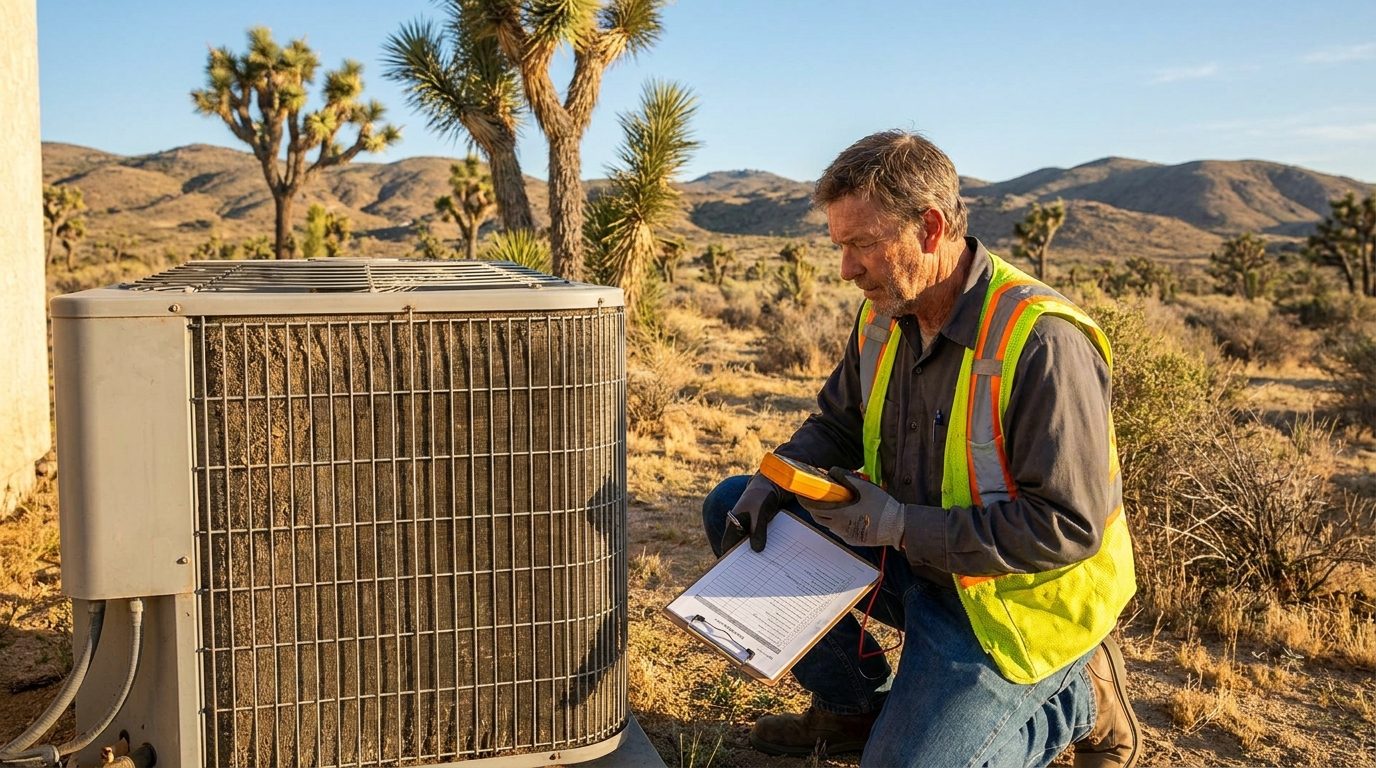
- Walk around the condenser and check for damage from winter weather, animal nests, or wind debris
- Clear debris within 2 feet of the unit, overgrown vegetation, leaves, blown-in trash
- Look at the fins, if they’re bent over from impact or pet damage, note it for the tech (we have a fin comb that straightens them)
- Check the refrigerant lines going into the house, the larger line (suction line) should be wrapped in foam insulation. Cracked or missing foam = note it for the tech, the system runs less efficiently with bare line
- Listen for vibration sources, anything rattling against the metal cabinet?
- Look at the concrete pad, is it level? A tilted pad stresses refrigerant lines over time
Filter check (5 minutes)
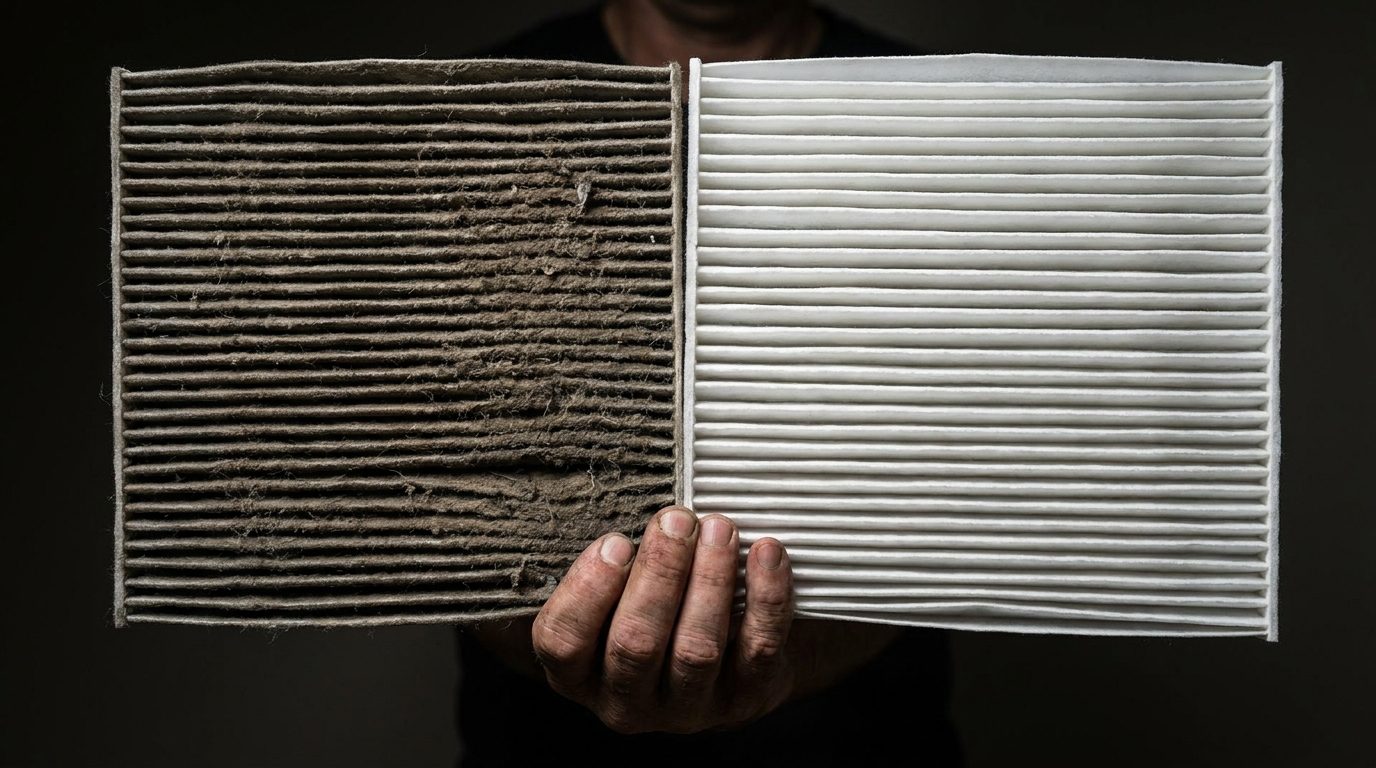
- Pull the filter from its slot
- Hold to a sunny window or shine a flashlight through it
- If you cannot see clear light: replace immediately
- Check the size stamped on the frame, note for buying replacements
- Reinstall with airflow arrow pointing into the air handler (toward the blower)
Thermostat (5 minutes)
- Replace batteries even if it seems fine (most thermostats use AA or AAA even when wired, battery backup matters)
- Pull the thermostat off the wall (gently, it slides off a base plate)
- Look at the wires, anything loose, corroded, or charred?
- Reseat firmly on the base plate
- Set to COOL, fan AUTO, setpoint 5°F below current room temp
- Wait 5 minutes and confirm the outdoor unit kicks on
Indoor unit (10 minutes, if you have attic or closet access)
- Check the condensate drain pan under the air handler, empty and dry is good
- Locate the condensate drain line (PVC pipe leading outside), pour a cup of distilled vinegar into the drain cleanout to flush algae
- Look for signs of refrigerant leaks at the indoor coil, oily residue is a tell
- Check supply registers in each room, clear any obstructions (furniture pushed against the wall, rugs covering)
- Check return-air grille, vacuum visible dust off the grille if needed
What requires a tech
These five items can’t be DIY-ed safely or accurately by a homeowner. They’re the reason a professional tune-up costs $129 vs free.
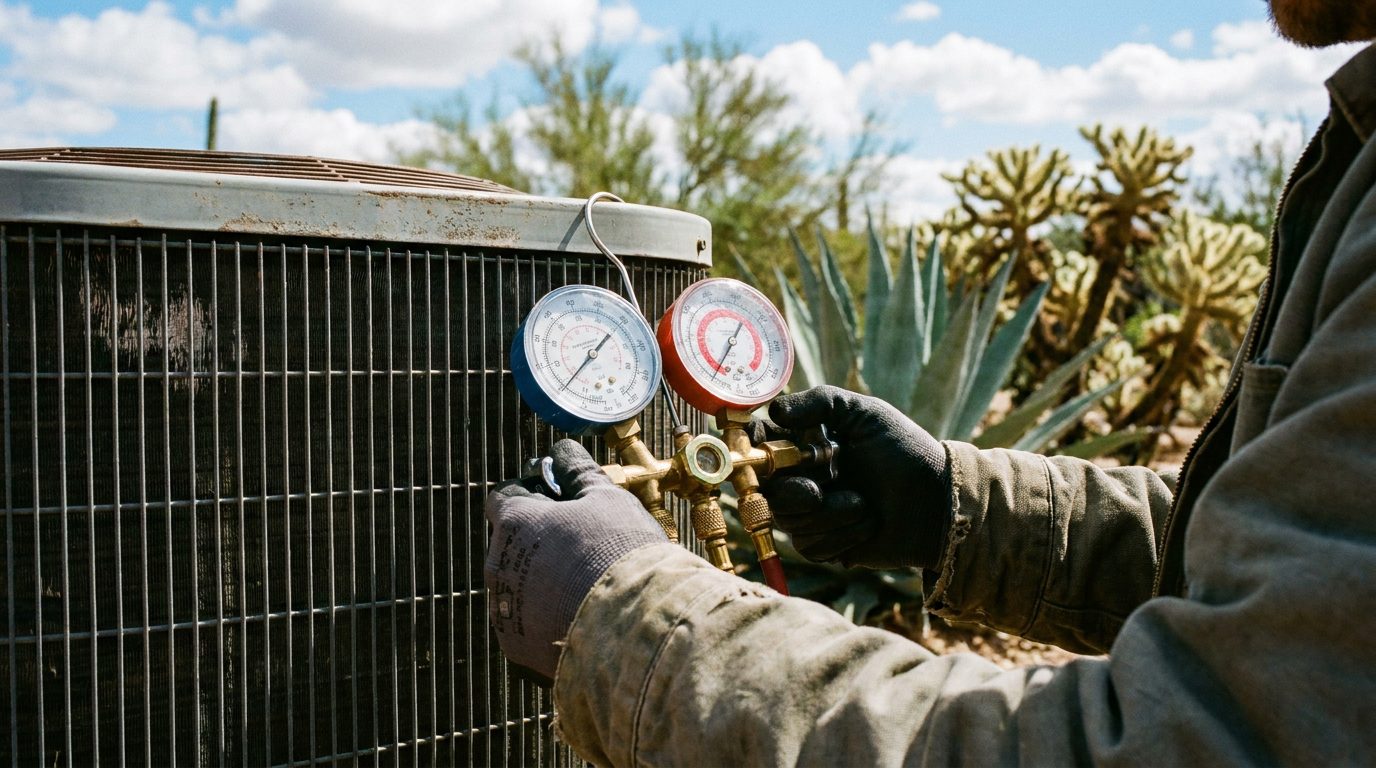
1. Refrigerant charge verification
Requires manifold gauges and an amp clamp. Tech measures:
- Subcooling (cooling mode), confirms refrigerant charge weight is correct
- Superheat (cooling mode), confirms refrigerant is fully evaporated before reaching compressor
- Indoor wet-bulb temperature, confirms cooling capacity is meeting design
- Supply + return air temperatures, calculates delta-T (should be 18-22°F in HD)
If any of these are off, the system runs inefficiently or risks compressor damage. Charging “by pressure alone” is wrong; we charge by weight or by precise sub/superheat measurements.
2. Electrical measurements
- Capacitor microfarads, measured against the rated value on the capacitor label. Capacitors degrade slowly; replacement at 90% of rated value prevents mid-summer failure
- Contactor resistance, pitting or burning on contactor points causes intermittent compressor failures
- Motor amp draw, outdoor fan motor + indoor blower motor amp readings flag bearing wear before catastrophic failure
3. Outdoor coil deep clean
Hose rinse from a homeowner removes loose debris but not the embedded grit + cottonwood seed + oil residue that accumulates after years of HD operation. We use a non-acid coil cleaner solution, let it foam for 5-10 minutes, then rinse from the inside-out. This restores heat-rejection capacity by 8-15% on neglected coils.
4. Indoor coil + drain inspection
The evap coil sits inside the air handler, often behind sealed panels. We open it, inspect for biofilm or dust loading, clean if needed, and check the drain pan + drain line. Algae buildup in the drain line is the #1 cause of mid-summer ceiling water damage.
5. Combustion safety (furnace side)
Even though it’s spring AC tune-up, we check the furnace at the same visit:
- Heat exchanger inspection (microscopic cracks let CO into airflow)
- Combustion analysis (CO ppm, O2, stack temperature)
- Flue draft test (confirms exhaust is moving out, not backing in)
This is critical safety, especially for propane households in Wrightwood/Phelan. Worth $0 to skip, but saves lives.
The tune-up math
Why we recommend annual tune-ups for HD homes:
| Scenario | Cost | Notes |
|---|---|---|
| Annual tune-up (1 per year) | $129/yr | Catches small issues before failure |
| Maintenance plan (2 visits/yr) | $19/mo = $228/yr | Spring AC + fall furnace + priority scheduling |
| Skip everything, deal w/ failures | $0/yr but $185-$320 emergency rate when something breaks | Average failure rate roughly 1 per 3 years on neglected HD systems |
For households planning to keep equipment 5+ more years, the maintenance plan typically saves $200-$400 over the period vs. break-fix.
Print-and-go DIY checklist
If you want a one-page version, here’s the DIY portion in checklist form:
SPRING AC DIY CHECKLIST
(30 min, do in March or April)

OUTDOOR UNIT
[ ] Walk around, look for damage
[ ] Clear vegetation/debris 2 ft around unit
[ ] Note any bent fins
[ ] Check refrigerant line foam insulation
[ ] Listen for vibration noises
[ ] Verify concrete pad is level

FILTER
[ ] Pull filter
[ ] Light test (replace if no light through)
[ ] Note size for replacements
[ ] Reinstall with arrow pointing INTO air handler

THERMOSTAT
[ ] Replace batteries
[ ] Check wire connections
[ ] Reseat on base plate
[ ] Set COOL, AUTO, 5° below room temp
[ ] Confirm outdoor unit kicks on in 5 min

INDOOR UNIT (if accessible)
[ ] Drain pan empty + dry
[ ] Pour vinegar into condensate drain cleanout
[ ] Look for oily residue at indoor coil (leak sign)
[ ] Clear obstructions from supply registers
[ ] Vacuum return grille

SCHEDULE
[ ] Call JCE for professional tune-up: 760-983-2326
When to call
Call 760-983-2326 for a spring tune-up. We schedule March-May appointments before mid-summer load fills the calendar.
See our maintenance services for tune-up details + maintenance plan options, or AC Running But Not Cooling? 7 Causes if something’s already wrong.