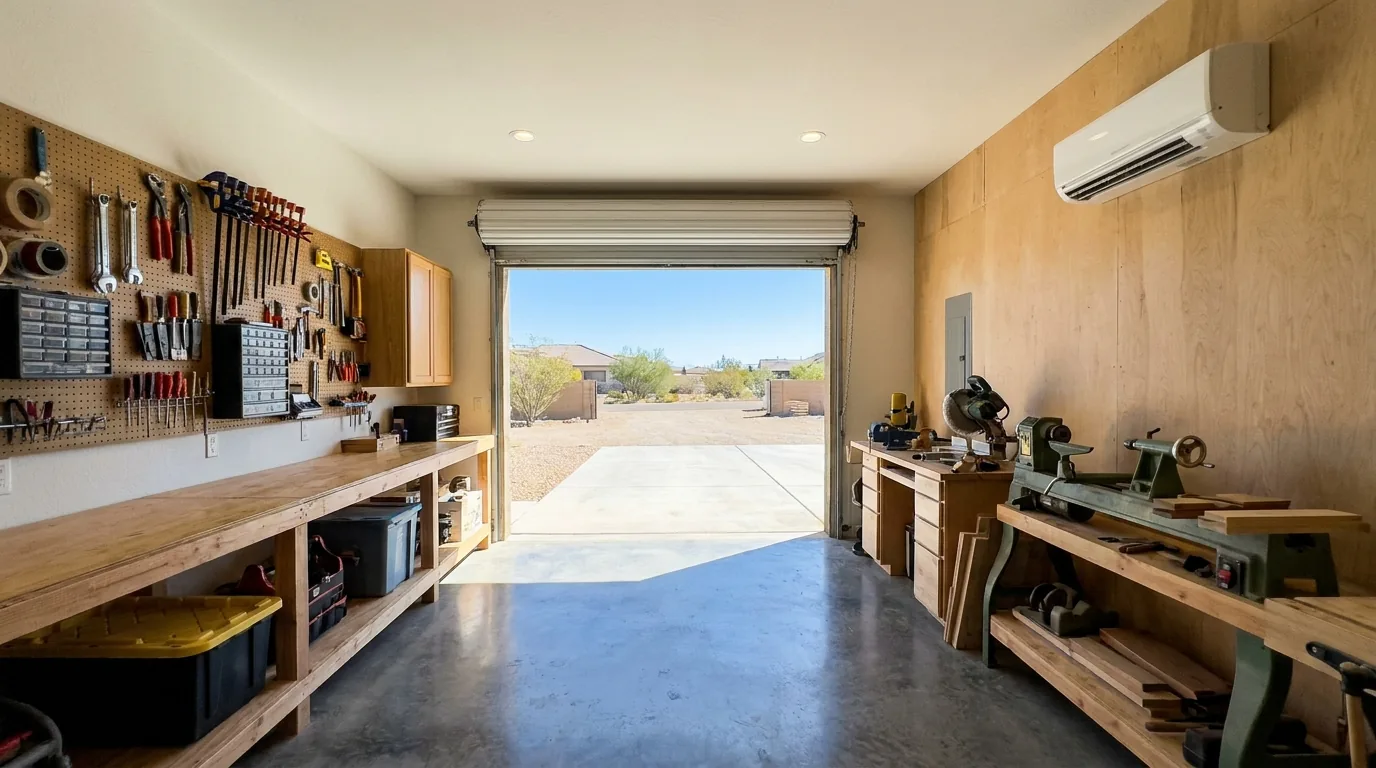
Garage and workshop mini-splits are one of the most common JCE call types because the High Desert climate makes uninsulated garage spaces unusable for half the year. Summer afternoon highs in the HD valley hit 110 to 115 degrees on the worst days, and an uninsulated detached garage can run 130+ inside by 4pm. Winter overnight lows drop to 25 degrees in the valley and into the high teens or lower at Wrightwood elevation, which makes any garage workshop unusable for woodworking, automotive work, or any task that needs steady hands.
The insulation question drives the load calc. Most HD garages were built with 2x4 framing and no wall insulation, with R-19 ceiling insulation if they are lucky. That means the load is much higher per square foot than a conditioned living space. A 400 sq ft uninsulated two-car garage often needs the same equipment as a 700 sq ft well-insulated bedroom. We measure the actual construction, not the square footage, before sizing equipment. When the homeowner is open to it, blown-in cellulose or batt insulation in the walls and ceiling cuts the load by 40 to 60 percent and lets a smaller mini-split do the job.
Single-zone wall mounts are the right answer for most standard two-car detached garages. A 12k BTU unit handles a 400 to 500 sq ft uninsulated two-car. An 18k BTU unit handles 500 to 700 sq ft or smaller insulated workshops with heavy heat-generating equipment (welders, compressors, kilns). For larger workshops, 24k to 36k BTU multi-head systems with two or three indoor heads handle the cascading effect: cold air from a single high-mounted head will not reach the back corners of a 30+ foot deep shop.
Electrical sub-panel needs come up on most installs. A standard detached garage is wired with one or two 20A circuits for outlets, plus maybe a 30A circuit for an opener and lights. Adding a mini-split usually needs a dedicated 15A or 20A 240V circuit, which often requires a small subpanel install if the existing garage feed is a single 60A or 100A run. We coordinate with a licensed electrician on subpanel work as part of the install.
Mounting height matters in tall shops. The cold-air cascade pattern from a wall-mounted indoor head only reaches about 12 feet of vertical drop before it loses velocity. Garages with high ceilings (10 to 14 feet at the peak on a typical detached garage) need careful head placement to avoid hot pockets at floor level. Our Hesperia office dispatches techs across the HD valley with typical travel time of 25 to 70 minutes depending on city. Heat pump mini-splits are our default recommendation because they handle both directions of the HD climate range and avoid the gas line work that a vented unit heater would require.