
The AC is running. Fan is blowing. But the air coming out of the vents is barely cool, room temperature, or sometimes outright warm. We see this call every July week from Hesperia through Victorville, Apple Valley, into Riverside.
Two-sentence answer: in the calls we run, the order of causes is thermostat setting (more often than you’d think), then dirty filter or dust-loaded outdoor coil, then capacitor failure, then refrigerant leak. Below is the full list of eight causes ranked by how often we actually see them, plus what to check before paying for a service visit.
Quick check first
Before any diagnostic, do this 60-second check:
- Walk to the thermostat. Confirm it’s set to COOL (not HEAT, not FAN, not AUTO if AUTO means heat/cool by season). Confirm the fan setting is AUTO, not ON.
- Set the temperature 5 degrees below the current room temperature reading.
- Wait 5 minutes. Walk to a supply register and hold your hand 6 inches in front of it.
If air is now cold, the thermostat was the issue. We’ll explain how that happens in #1 below. If it’s still warm, work down the list.
1. Thermostat set wrong (more common than you’d guess)
This is the most common “warm air” call we run, and homeowners are always embarrassed when we find it. Top three scenarios:
- Fan set to ON instead of AUTO. When the fan is on ON, it runs continuously, including during the gap between cooling cycles. During that gap, the AC compressor is off but the fan is still pushing air through the (now-warming) coil and out the vents. Air comes out lukewarm. Switch to AUTO and the problem disappears.
- Thermostat set to HEAT in summer. Yes, really. Programmable thermostats sometimes default to heat mode after a power outage or a battery swap. The fan will run, the system will pretend to call for heat (no gas, no flame, just blower air), and you’ll feel barely-warm air.
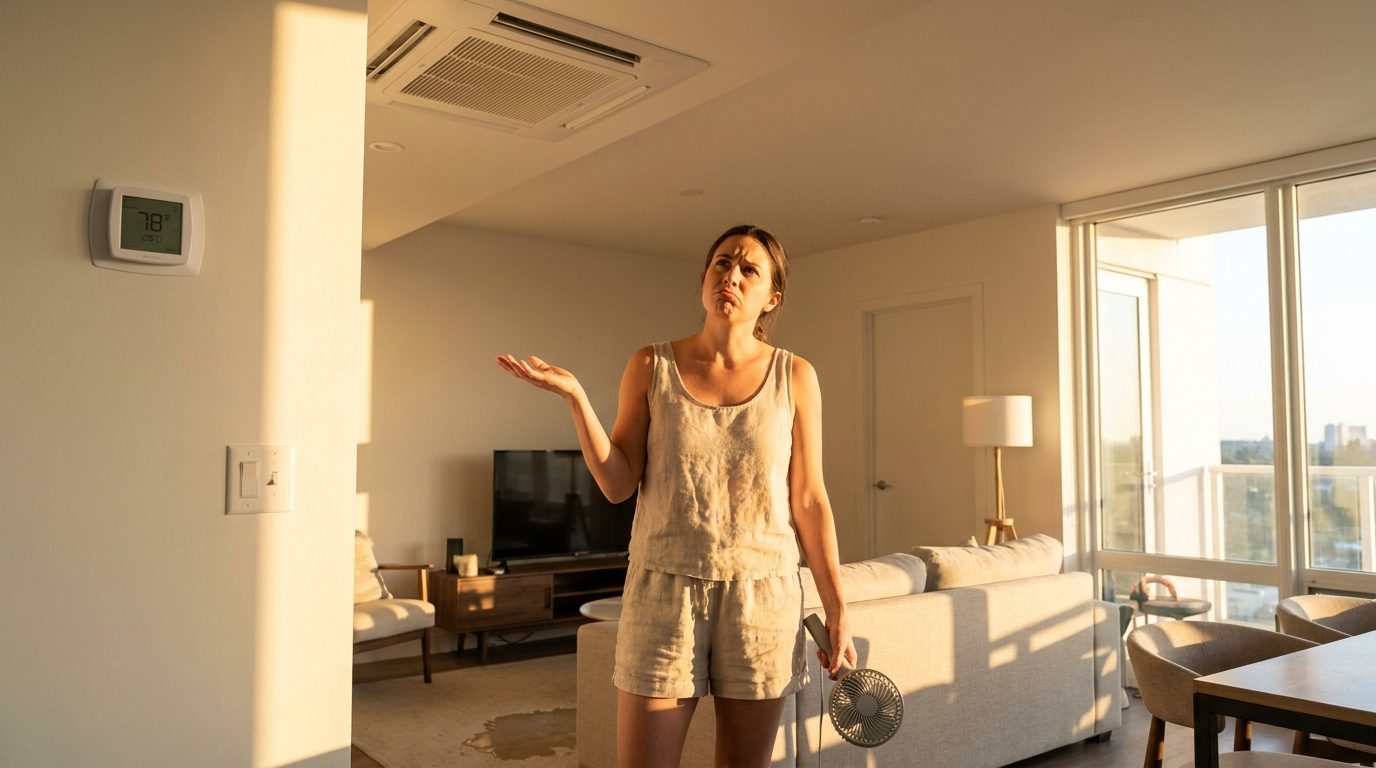
- Setpoint above room temp. If your indoor temperature is 76°F and the thermostat is set to 78, the AC isn’t cooling because it doesn’t think it needs to. The fan may still run for circulation depending on settings.
Cost to fix: $0. We’ve been called out for this at full service-call rate more times than we like.
2. Outdoor breaker tripped
The outdoor condenser has its own breaker, separate from the indoor air handler. If it tripped, common after a Santa Ana wind event, a brownout, or an electrical surge, the indoor blower will keep running on its own breaker but the outdoor unit will be off. Result: fan blowing, no cooling.
Check the panel. Look for any breaker that’s halfway between ON and OFF (the visual giveaway of a tripped breaker). The condenser breaker is usually labeled “AC” or “Condenser” and is typically a 30A or 40A double-pole. Reset it once. If it trips again immediately, stop and call us, repeated tripping means a short circuit and continuing to reset can damage the compressor.
3. Clogged air filter
In the High Desert, filters load up faster than coastal homes. Cottonwood seed, fine dust, wildfire smoke during fire season, a 30-day filter can be unusable at 45 days. When the filter chokes airflow to the indoor coil, the coil temperature drops below freezing and ice forms. Ice on the coil blocks heat transfer, the refrigerant can’t move heat, and the air at the vents goes from cool to lukewarm to warm.
Pull the filter. Hold it against a light bulb or sunny window. If you cannot see light through the filter material, replace it. Then turn the AC OFF, set the fan to AUTO, and wait 2-4 hours for any ice on the coil to melt. Then restart. If cool air returns, you found the problem. If not, it’s downstream.
4. Dust-loaded outdoor coil
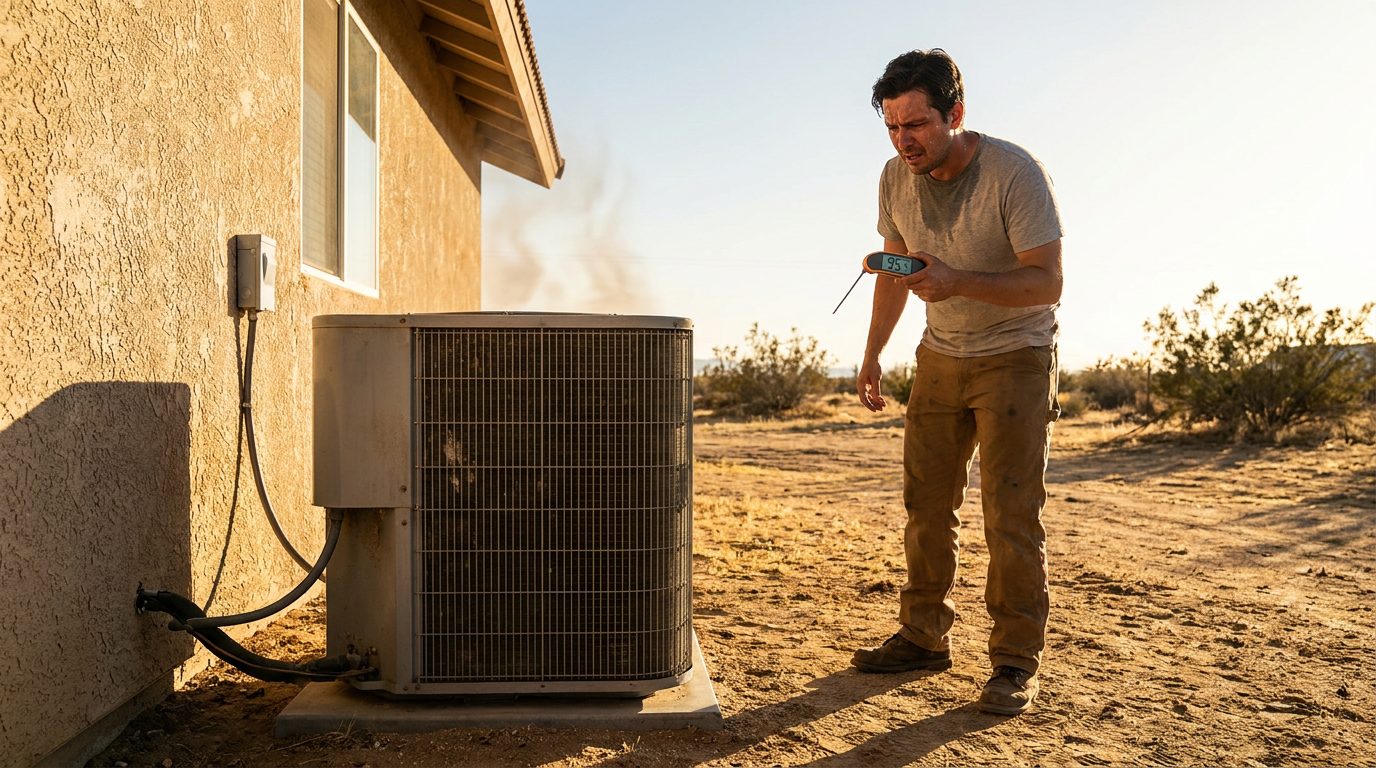
The outdoor coil’s job is to dump heat from inside the house to the outside air. When the coil’s aluminum fins are clogged with HD dust, cottonwood seed, dryer lint from a nearby vent, or grass clippings, it can’t reject heat efficiently. The compressor runs but refrigerant pressures climb out of range, the system goes into a fault state or just inefficient operation, and the cool air at the vents drops to lukewarm.
Walk outside. Look at the side fins of the outdoor unit. If they’re packed with debris, the coil needs cleaning. Power off at the disconnect (the gray box on the wall next to the unit). Gentle hose rinse from the inside-out, water flowing outward through the fins, not inward (inward bends the fins). NOT a pressure washer. Let dry 30 minutes, restart.
Annual coil cleaning is part of our maintenance tune-up. In HD, we recommend twice-yearly cleaning because of the dust load.
5. Failed capacitor (outdoor unit)
The start/run capacitor lives inside the outdoor unit electrical compartment. It gives the compressor and fan motor their initial kick. In HD heat, capacitors degrade fast, we’ve replaced 6-year-old capacitors that read perfectly in May and failed in July.
The classic symptom for warm-air calls: outdoor fan is not spinning, OR fan spins but compressor is silent. The unit may hum or buzz. Inside, the air at the vents goes from cool to room temperature within 20-30 minutes of the capacitor failure as the indoor coil’s stored cold drains away.
A capacitor replacement is one of our fastest service calls, 30 minutes start to finish, and runs $185 to $325. We carry common sizes on every truck.
6. Low refrigerant from a leak
AC systems do not consume refrigerant during normal operation. If you are low, you have a leak.
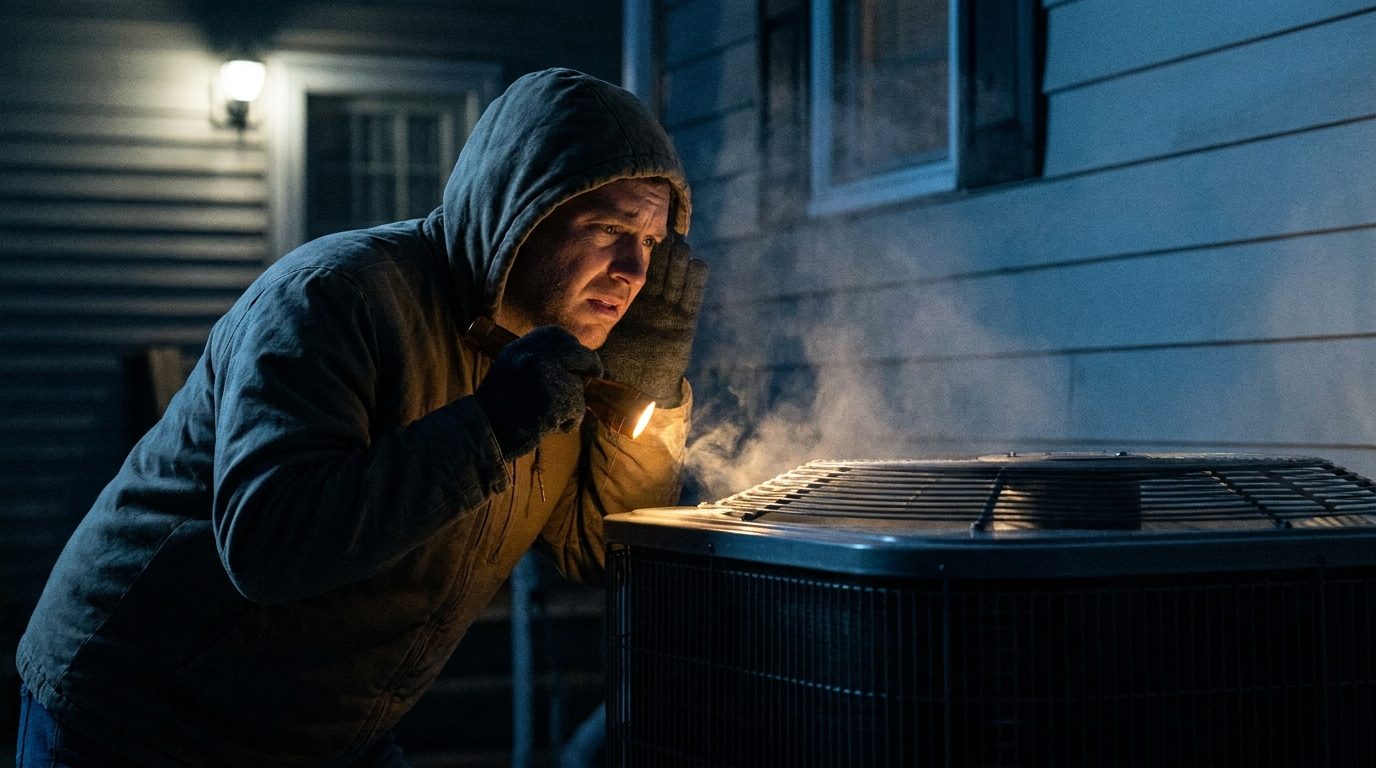
Symptoms: vent air is “almost cool” but not properly cold. The large copper line outside (suction line) may be frosted or icy. The indoor coil may freeze and then unfreeze in cycles, dripping water from the air handler. You may hear a faint hissing at the line set or evaporator coil if the leak is large.
Bad shops add refrigerant and send you on your way. We pressure-test with nitrogen, leak-search, repair the leak, evacuate the system to remove moisture and air, then recharge to the manufacturer-spec weight (not just to a target pressure). Repair-and-recharge runs $650 to $1,400 depending on leak location. Coil leaks are at the high end; valve-stem and joint leaks are at the low end.
7. Frozen evaporator coil (downstream of any of #3, #4, #6)
If you check the indoor unit and see water dripping from the air handler housing onto the floor, or you see ice on the larger refrigerant line, the evaporator coil inside has frozen up. The AC can’t cool when the coil is iced because the refrigerant can’t pick up heat through the layer of ice.
This is always a symptom of one of three upstream issues: dirty filter, low refrigerant, or failing blower motor. Switch the thermostat to OFF (not COOL). Leave the fan setting to AUTO so the blower stops too. Wait 2-4 hours minimum for the ice to fully melt and the drain pan to clear. Replace the filter. Restart in COOL mode. If cool air comes back and stays, your filter was the upstream cause. If the coil freezes again within a day, you have a refrigerant or airflow issue and need a service call.
8. Compressor failure
Compressor failure is rare and almost always preceded by other symptoms over weeks or months. When it happens, the outdoor unit’s fan may spin, the contactor may pull in audibly, but no cooling work is being done because the compressor isn’t pumping refrigerant.
Failure modes we see: locked rotor (compressor mechanically seized), electrical short to ground, valve damage from running on low refrigerant for too long. Cost to repair a compressor on an existing system is $1,800 to $3,500. At that price point, we usually recommend replacing the entire outdoor condenser instead, $3,200 to $5,800 installed for a new condenser, with full manufacturer warranty, vs. a compressor-only swap that doesn’t extend warranty on the rest of the old unit.
Quick reference
| Cause | Frequency | DIY check? | Repair cost |
|---|---|---|---|
| 1. Thermostat set wrong | Very common | Yes | $0 |
| 2. Outdoor breaker tripped | Common | Yes | $0 unless underlying issue |
| 3. Clogged filter | Common | Yes | $0-$25 (new filter) |
| 4. Dust-loaded outdoor coil | Common in HD | Yes | $129 (tune-up) |
| 5. Failed capacitor | Common | Visual | $185-$325 |
| 6. Refrigerant leak | Common | No | $650-$1,400 |
| 7. Frozen evaporator | Symptom of 3, 6, or 8 | Yes | varies |
| 8. Compressor failure | Rare | No | $3,200-$5,800 (replace condenser) |
When to stop troubleshooting and call
Some “warm air” symptoms need a tech immediately, not a homeowner check:
- The breaker has tripped more than once
- You see ice on any refrigerant line
- You smell anything burning or chemical (refrigerant has a faint sweet smell when leaking; a real chemical or burning smell is dangerous)
- The indoor unit is dripping water onto the ceiling or floor and the drain pan isn’t catching it
- The indoor temperature has been climbing for more than two hours and is now over 85°F
Call us at 760-983-2326. Same-day dispatch in most cases between Hesperia and Lucerne Valley; same-day or next-day across the Inland Empire. After hours and weekends, 24/7 emergency dispatch with no after-hours upcharge, the diagnostic fee is the same regardless of time of day.
For more on AC troubleshooting and repair, see our AC repair service page or read the AC repair cost guide. If you’ve worked through this list and the AC is still not cooling but blowing genuinely warm air, the related post AC Running But Not Cooling? 7 High Desert Causes covers the borderline cases.