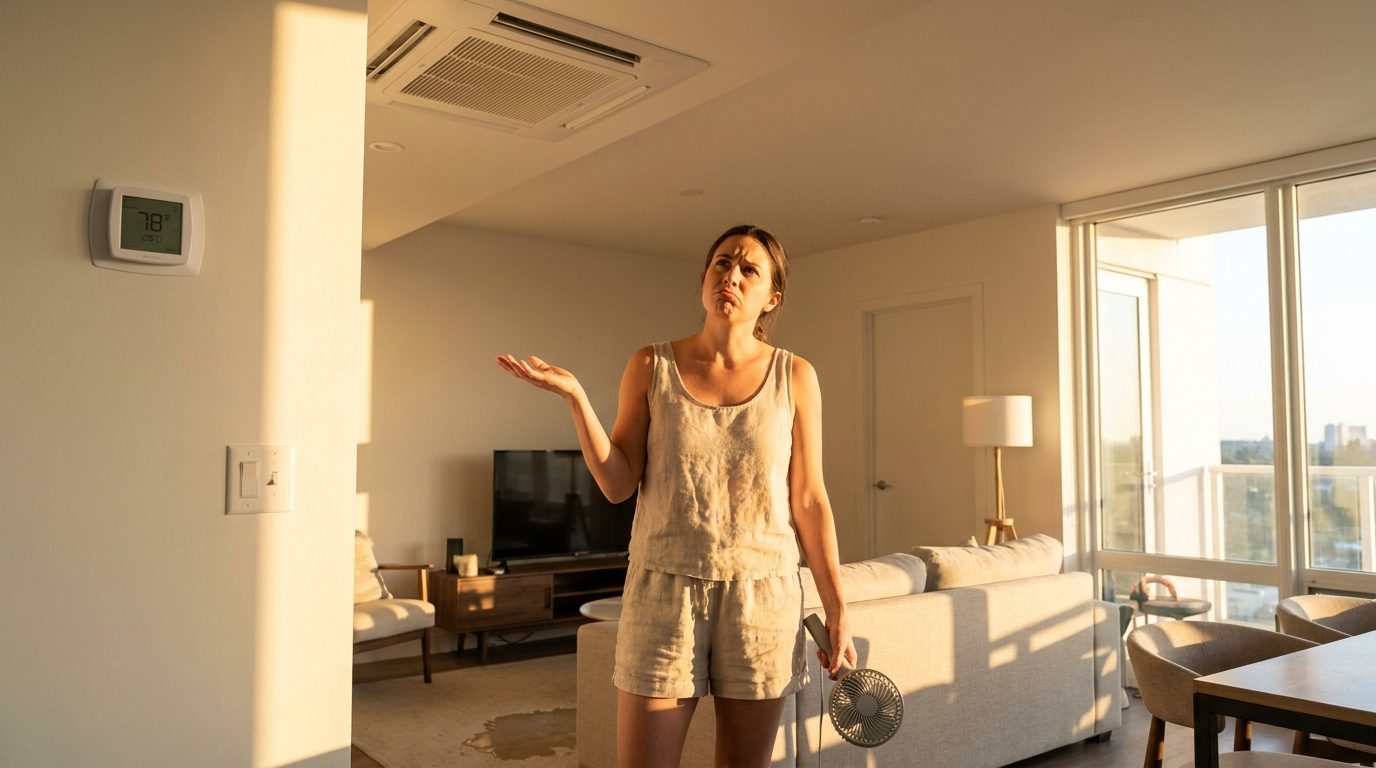

The first 95-degree day in the High Desert usually hits between May 18 and June 8. If your AC has been sitting all winter, that’s the moment it gets put through its hardest test of the year, going from idle to a 30-40 degree pull on the indoor temperature. That’s when capacitors fail, refrigerant leaks reveal themselves, and clogged filters ice the coil.
Two-sentence answer: spend 30-45 minutes on the 5 checks below before the first hot day. Doing this in May saves a 2 AM emergency call in July when everyone in HD has the same problem and dispatch wait times stretch.
Below are the five pre-season checks JCE techs run on AC service calls around Hesperia and across the High Desert, written so any homeowner can do them.
1. Replace the filter (5 minutes)
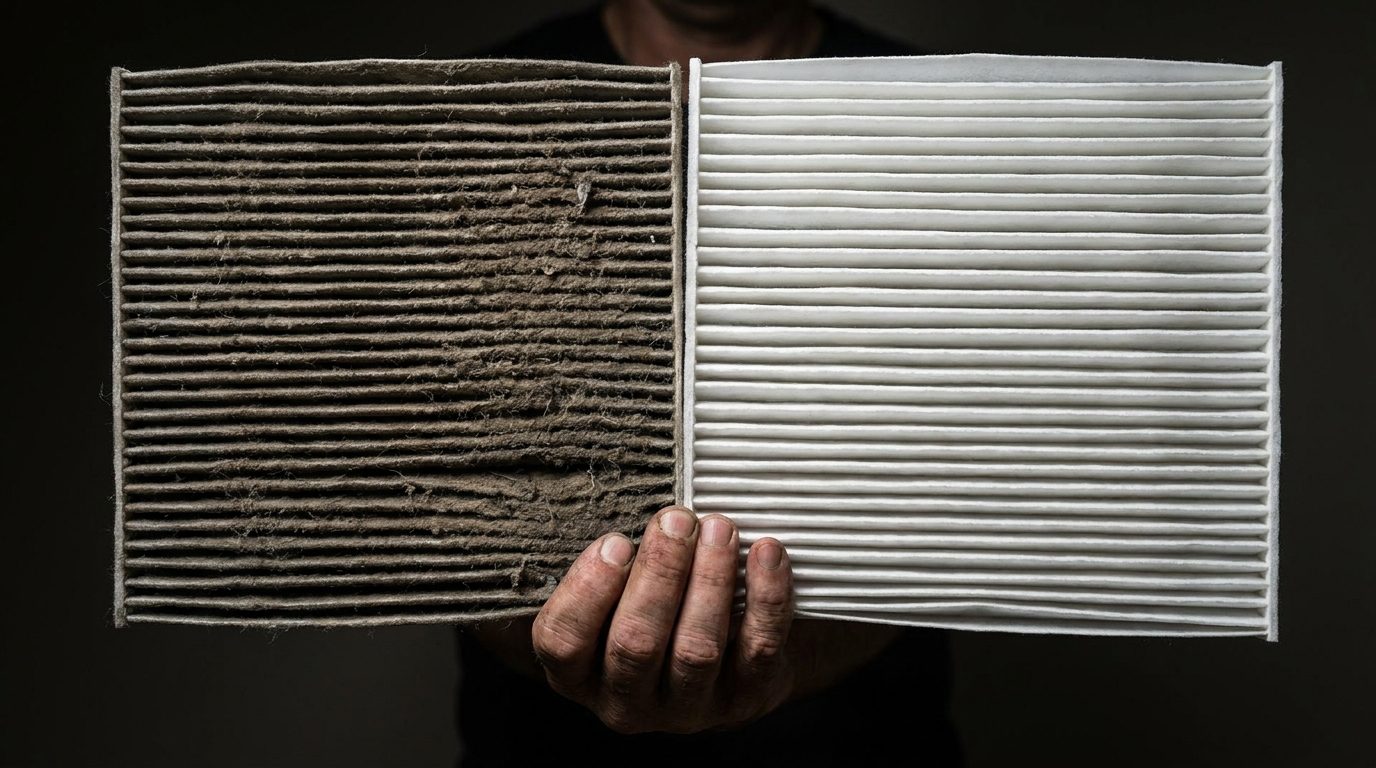
Winter accumulates dust at a slower rate than summer, so it’s tempting to skip the May filter swap. Don’t. A partially-clogged filter restricts airflow on the first hot day, the evaporator coil ices over, the system shuts down, and you call us thinking the AC failed when it just needed a $15 filter.
How: Pull the filter from the return air slot or air handler. Hold it to a light bulb. If you can’t see clear light through it, replace it. MERV 8-11 is the HD sweet spot (good filtration without straining the blower).
HD tip: If your home is near unpaved roads (parts of Phelan, Lucerne Valley, rural Hesperia), upgrade filter change cadence to every 30-45 days through summer. The fine red dust in HD air is brutal.
See our HVAC filter cadence guide for the full schedule.
2. Clear the outdoor unit (10 minutes)
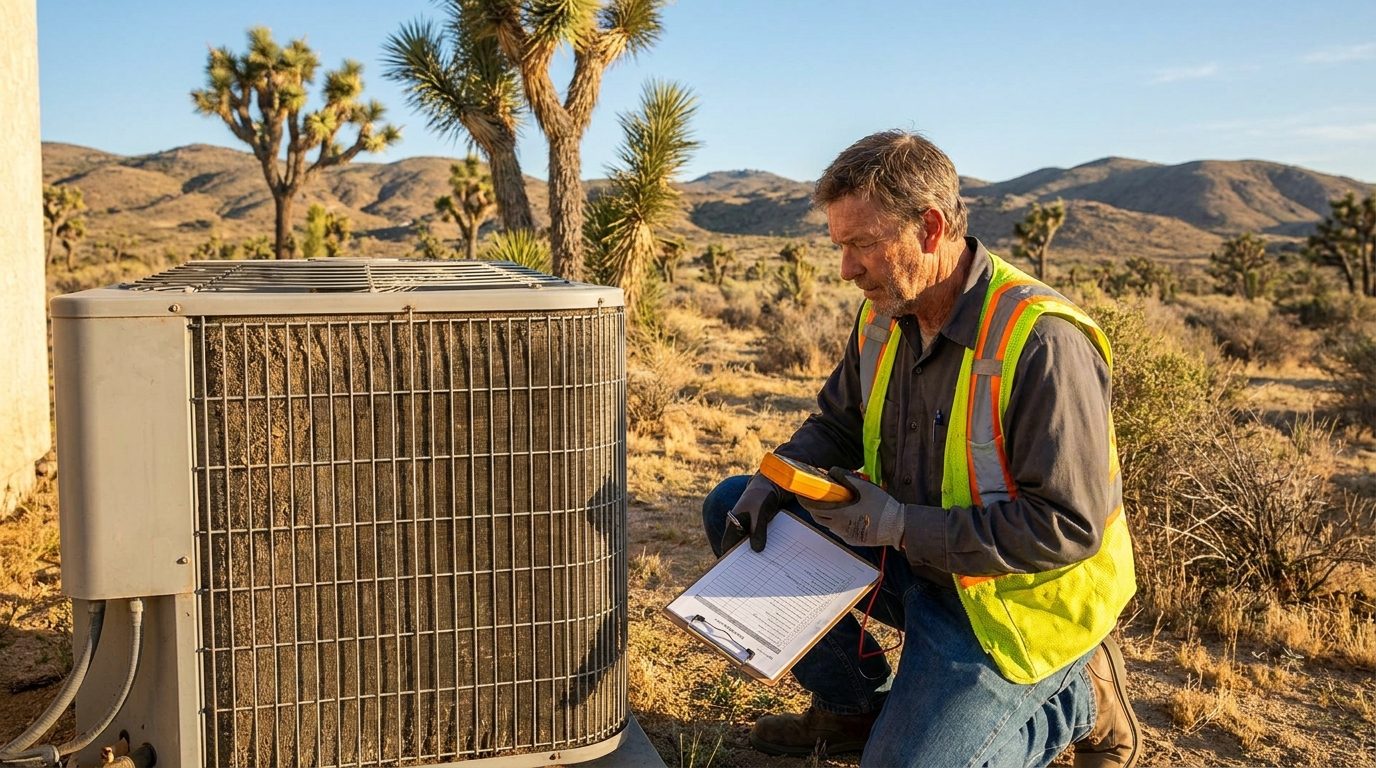
The condenser sat through winter wind events and possibly snow. Sage brush, tumbleweed pieces, leaves, and dust pile up in and around it. A blocked outdoor unit cannot reject heat properly, which on a 105F day means the system shuts down on high-pressure lockout.
How:
- Walk around the outdoor unit. Pick up debris from the surrounding 3 feet of ground clearance.
- Look through the fins. If you see leaves, dust mats, or plastic bags caught against the coil, blow them out with a leaf blower OR rinse gently with a garden hose (no pressure washer, fins bend).
- Check above the unit for tree branches, hanging cords, or birds nests in eaves nearby.
- Confirm the gray disconnect box on the wall next to it has the handle fully seated in the ON position. HD wind events knock disconnects loose.
HD tip: If you have artificial turf or a pet area within 5 feet of the condenser, hose down the surrounding area too. Pet hair, turf fibers, and grit get sucked into the unit.
3. Listen to a test cycle (15 minutes)
This is the most important check. Run the AC for 30 minutes on a cool day in early May while you’re home. You’re listening for:
- Capacitor failure (hum without start): AC tries to start but only hums, no compressor or fan. Cycles off after 30 seconds.
- Bearing wear (grinding/squealing): Outdoor fan motor making mechanical noise.
- Refrigerant leak (hissing): Faint hiss near outdoor lineset connections.
- Loose panel (rattling): Outdoor cabinet panel vibrating, easy fix with a screwdriver.
A working system sounds like steady airflow from supply vents, a low hum from the outdoor compressor, and a quiet fan. Anything else is a warning.
HD tip: If the system has not run since October, expect a 60-90 second startup delay while compressor windings warm and refrigerant equalizes. That’s normal. If it still hasn’t started after 2 minutes, shut it off and call us.
See our compressor sounds guide for what each noise means.
4. Reset the thermostat schedule (5 minutes)
If you have a smart thermostat (Nest, Ecobee), winter heating schedules are still active. They will conflict with summer cooling targets and you’ll wonder why the AC kicks on at 5 AM when it’s 68F outside.
How:
- Switch system mode from HEAT to COOL (or AUTO if you trust your system)
- Reset the schedule for summer (we recommend 78F daytime / 74F sleep / 82F away)
- Replace AA/AAA backup batteries even if it’s a wired thermostat
- If you have a C-wire, confirm thermostat shows a charge bar or wired status, not battery
HD tip: SCE TOU-D-PRIME peak hours are 5-8 PM, on-peak rate is roughly 3x off-peak. Set thermostat to pre-cool to 74F at 4 PM, then bump to 78F at 5 PM. You ride out the peak window on stored coolness, not active compressor draw.
See our thermostat settings guide for the full math.
5. Look at the disconnect + breaker (5 minutes)
Two things to check at the electrical side:
Outdoor disconnect:
- The gray box on the wall next to the condenser
- Open it. Is the cartridge handle/fuse fully seated and in the ON position?
- Look for rust, scorch marks, or melted insulation. Any of those = call us.
Indoor breaker panel:
- Locate the AC and Furnace/Air Handler breakers
- Confirm both are fully ON, not in the middle “tripped” position
- If a breaker has tripped over the winter, reset once. If it trips again immediately, stop and call us. Tripping breakers indicate either a short or an overload condition that won’t fix itself.
The 5-minute professional tune-up upsell
The 5 checks above catch about 80 percent of pre-season failure modes. The other 20 percent require equipment most homeowners don’t have:
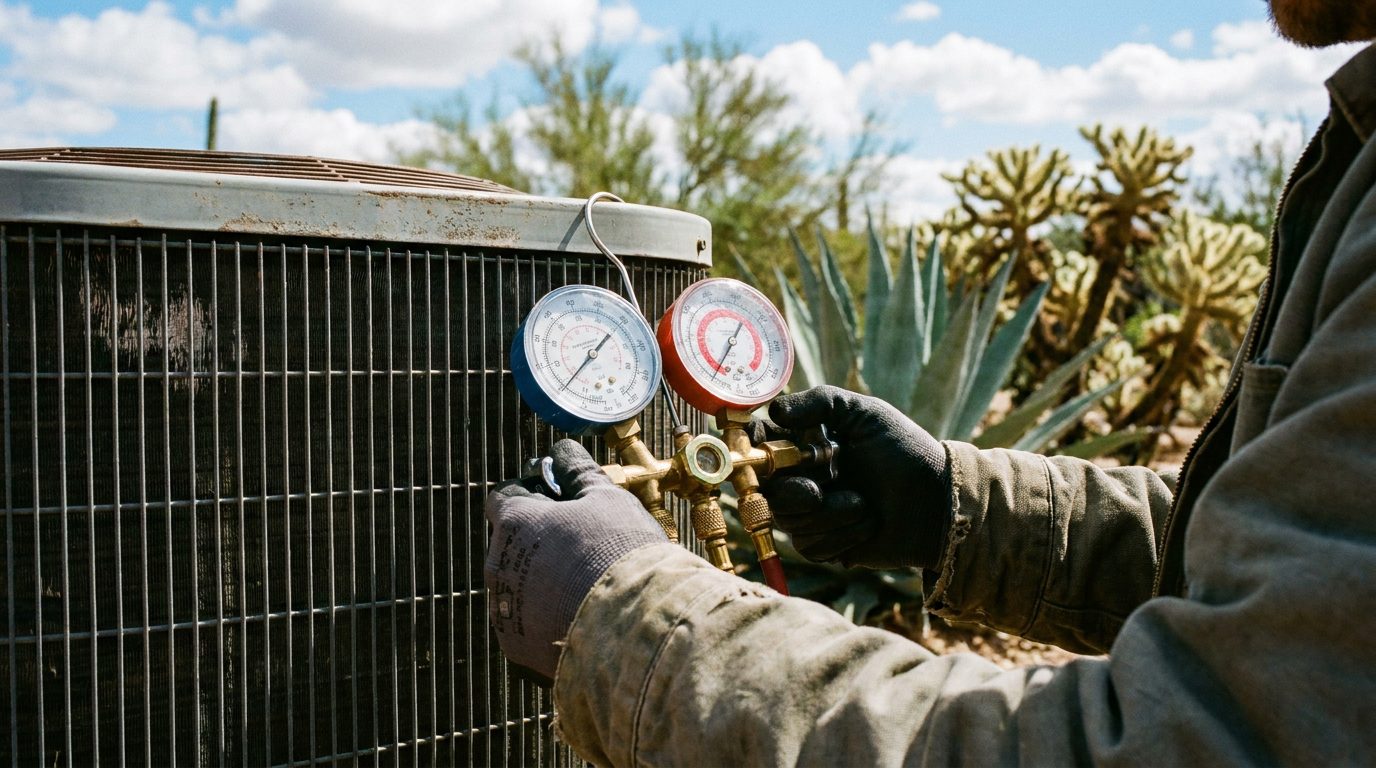
- Manifold gauges, measure refrigerant pressure to confirm proper charge
- Multimeter, test capacitor microfarads against rated value (visual inspection misses degraded but not yet failed capacitors)
- Combustion analyzer, verify safe operation if you have a furnace combined with the AC
- Coil cleaner + non-acid cleaner, actual coil cleaning (not just blowing leaves)
A JCE spring tune-up runs $129 and includes the homeowner-impossible checks. We catch about 1 in 4 systems we tune up needing a non-emergency repair, which is way cheaper than the 2 AM emergency dispatch + parts in August.
See our spring tune-up post for what’s actually measured and documented on every visit.
Quick reference
| Check | Time | Cost (DIY) | Failure mode caught |
|---|---|---|---|
| Filter swap | 5 min | $0-$25 | Coil icing, airflow loss |
| Outdoor unit clear | 10 min | $0 | High-pressure lockout |
| 30-min test cycle | 15 min | $0 | Capacitor, bearing, refrigerant |
| Thermostat reset | 5 min | $0-$8 (batteries) | Cycling errors |
| Disconnect + breaker | 5 min | $0 | Electrical failure pre-summer |
| Total | 40 min | $0-$33 | 80 percent of pre-season fails |
| Professional tune-up | 60 min (their time) | $129 | Remaining 20 percent + documentation |
When to call
If anything in the test cycle sounded wrong, the breaker trips on first attempt, or the outdoor unit is making mechanical noise, call 760-983-2326 now. Mid-May dispatch wait is under 24 hours. By July 15 it’s 3-5 days.
For a $129 spring tune-up before the first hot week, schedule via our maintenance page or call. We’ll be in your area regardless of where in HD you are.